
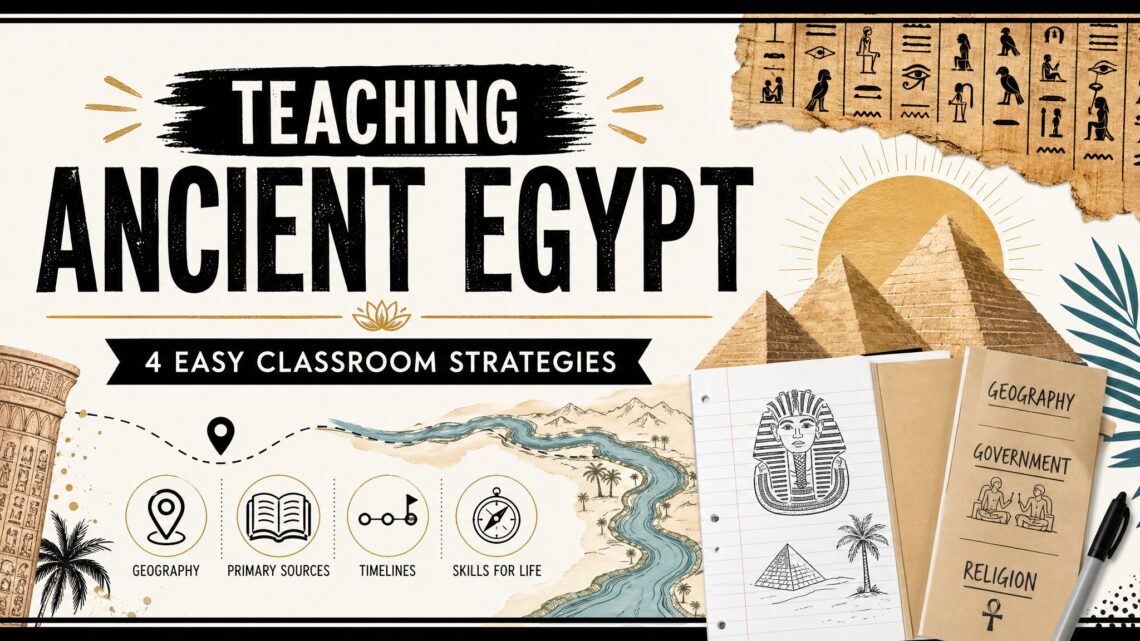
4 Easy Ways to Teach Ancient Egypt in Middle School Social Studies
Teaching Ancient Egypt is one of those units that students usually want to love. Pyramids, pharaohs, hieroglyphics, the Nile — it all feels big and mysterious. The tricky part is helping students organize all of that excitement into clear, usable understanding.
If you teach middle school social studies, these four classroom strategies can help students connect the major parts of Ancient Egypt without turning the unit into a giant pile of disconnected facts.
1. Start with the Nile and geography
Before diving into pharaohs or pyramids, start with the geography. A quick map activity helps students see why the Nile River mattered so much. Have students label the Nile, surrounding deserts, major cities, and the Mediterranean Sea, then ask them to explain how geography shaped farming, transportation, trade, and settlement.
This is a simple way to make Ancient Egypt feel less random. Students begin to understand why Egypt is often called the “gift of the Nile” and how physical geography influenced nearly every part of daily life.
2. Use GRAPES to organize the whole unit
Ancient civilizations can get overwhelming fast, especially for middle school students. The GRAPES framework gives them a clean structure for sorting information:
- Geography
- Religion
- Achievements
- Politics/Government
- Economy
- Social Structure
Instead of memorizing isolated facts, students can place each new detail into a category. Pharaohs connect to government, pyramids connect to religion and achievements, papyrus connects to economy and achievements, and the Nile connects right back to geography.
3. Give students a hands-on foldable brochure
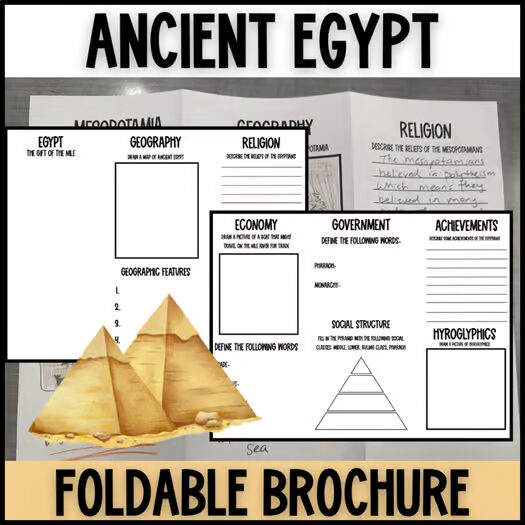
A foldable brochure is an easy way to turn Ancient Egypt notes into something students can actually use. Students can complete one panel for each major GRAPES topic, add quick drawings, and summarize the most important ideas in their own words.
I made a free Ancient Egypt foldable brochure activity for exactly this purpose. It includes a ready-to-use six-panel template with sections for geography, religion, government, social structure, economy, and achievements. Students can use it as an interactive brochure, review tool, or concise study guide.
It works especially well after students have learned the basics, because it asks them to choose the most important information and organize it clearly. That little bit of summarizing goes a long way.
4. Add short source or image analysis moments
You do not need a long document packet to build historical thinking into your Ancient Egypt unit. A single image, artifact, map, or short quote can work beautifully.
Try showing students an image of hieroglyphics, a pyramid, an Egyptian social pyramid, or a map of the Nile River Valley. Then ask three quick questions:
- What do you notice?
- What does this show us about Ancient Egypt?
- Which GRAPES category does this connect to?
These short check-ins help students practice observation and evidence-based thinking without slowing the whole unit down.
Bring the unit together
When students can connect geography, religion, government, economy, social structure, and achievements, Ancient Egypt starts to make sense as a civilization — not just a list of cool facts. A mix of maps, GRAPES organization, hands-on notes, and quick source analysis can make the unit more engaging and easier to remember.
If you want a simple no-prep resource to support that structure, you can grab the free Ancient Egypt Foldable Brochure here.
Ready-to-use classroom resource
Want this social studies resource ready to print?
Save planning time with a classroom-ready activity built for upper elementary and middle school teachers.
View the resource
