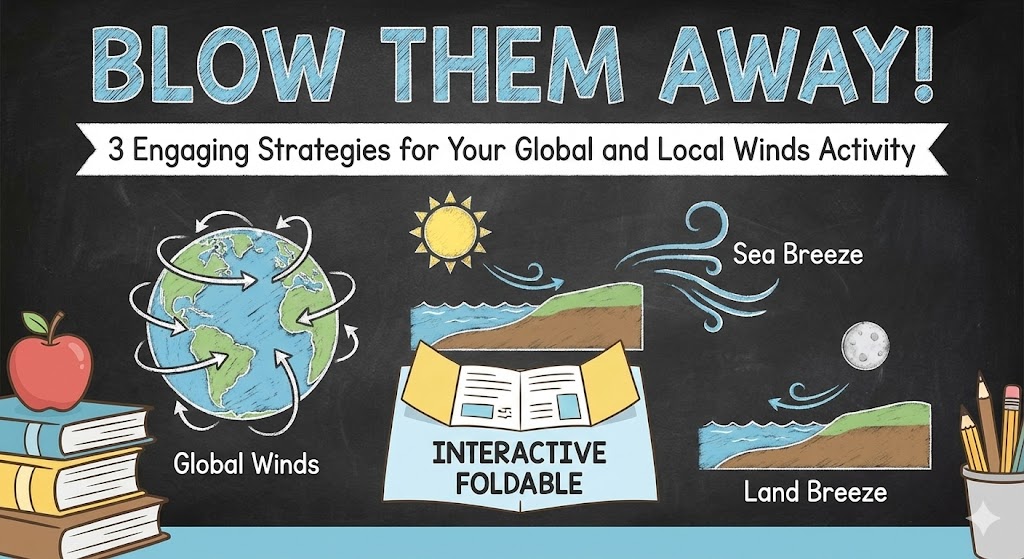
Blow Them Away! 3 Engaging Strategies for Your Global and Local Winds Activity
Wind is hard to teach because students cannot hold it, pass it around, or look at it under a microscope. They feel it every day, but the science behind global and local winds can still feel invisible.
When I plan a global and local winds activity, I want students doing more than copying arrows. They need to connect wind to unequal heating, pressure, convection, Earth’s rotation, and real examples like sea breezes and land breezes.
Give students something to build or fold
Interactive notebook pieces are great for this topic because students need an organized place to put several similar-sounding terms. Trade winds, westerlies, polar easterlies, sea breeze, land breeze—it is easy for all of that to turn into word soup.
I created this Global & Local Winds Foldable to help students sort the information in a more visual way.
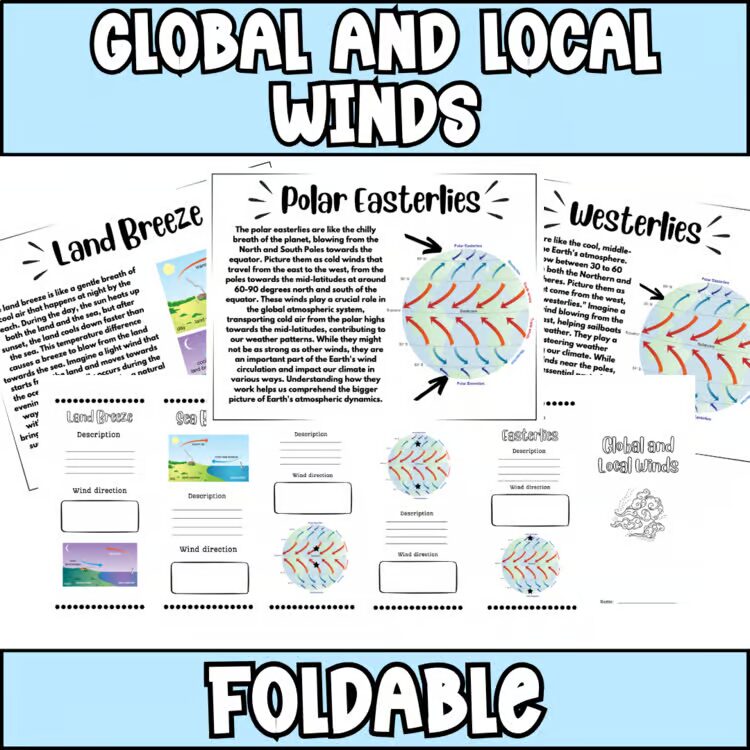
I like foldables because they slow students down just enough. They cut, sort, label, and explain. It is not magic, but that little bit of hands-on organization can make a hard Earth science concept feel more manageable.
Act out convection and air movement
Middle schoolers remember movement. Have students use their hands or bodies to show warm air rising and cool air sinking. Then connect that motion to pressure differences and wind.
It might feel a little silly, but silly is not always bad. If students can physically show the process, they are more likely to remember it later when the diagram shows up on a quiz.
Use real weather examples
Local winds are much easier when students connect them to real places. Beaches, lakes, cities, mountains, and daily temperature changes all give you a way to make the concept practical.
You can also connect this lesson to air masses and weather fronts or ocean currents. Earth science topics make more sense when students see how one system affects another.
A good global and local winds activity should help students see the invisible. Give them visuals, movement, and a clear way to organize the vocabulary, and the wind patterns start to stick.
Classroom-ready resource
Want the ready-to-use version?
If you want the activity without building it from scratch, this resource is ready to print, share, and use with upper elementary or middle school students.
Grab free no-prep science & social studies resources
Get instant access to review templates, vocabulary posters, gallery walk samples, quick-check activities, and hands-on practice ideas for upper elementary and middle school.