
Teaching Holes Character Traits Without Another Boring Worksheet
If your students are reading Holes, you already know the characters are one of the best parts of the novel. Stanley, Zero, The Warden, Kate Barlow, Madame Zeroni, and the boys at Camp Green Lake all give students so much to notice, infer, and discuss.
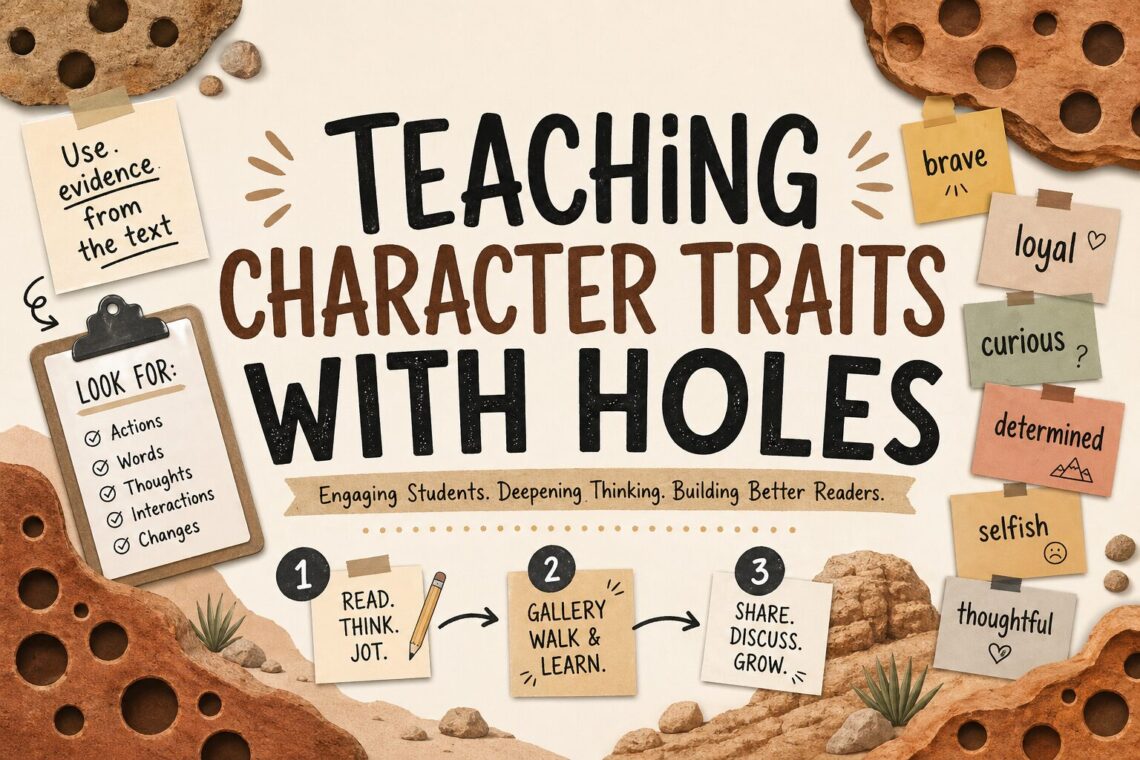
The tricky part is helping students move beyond quick labels like “nice,” “mean,” or “brave.” A strong Holes character traits lesson gives students practice using text evidence, noticing character development, and explaining how each character fits into the larger story.
Start with traits students can actually prove
Before students analyze every character, I like to slow down and make sure they understand that character traits need proof. Instead of asking, “What is Stanley like?” try asking, “What does Stanley do, say, or think that proves that trait?”
This simple shift keeps the lesson rooted in reading comprehension instead of guessing. It also helps upper elementary students explain their thinking more clearly when they write about characters later.
Use a gallery walk to make character analysis more active
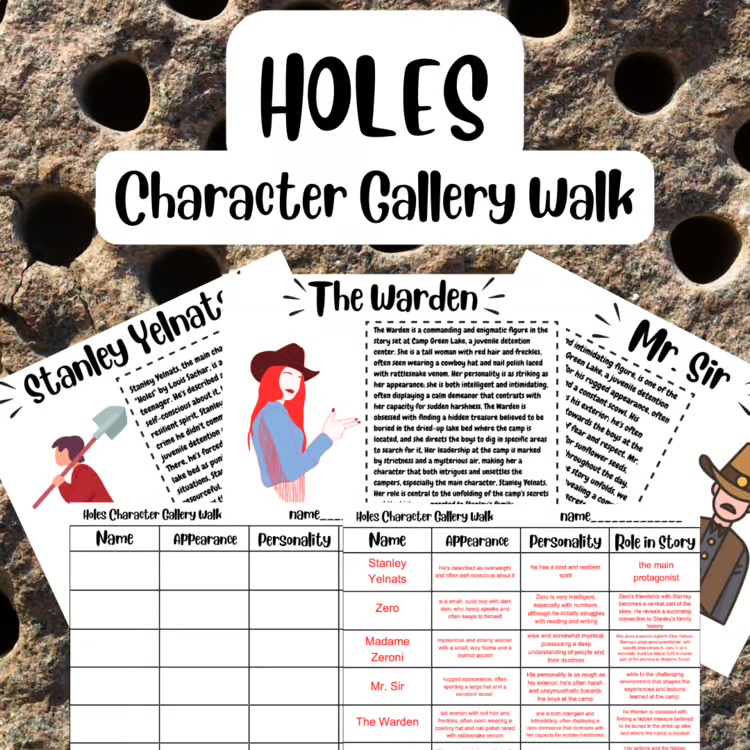
A character traits gallery walk is one of my favorite ways to turn a Holes novel study into something more engaging. Students move around the room, read short character descriptions, and record details about each character’s appearance, personality traits, and role in the novel.
That movement matters. It breaks up the routine of sitting with a packet, and it gives students a natural reason to revisit multiple characters without feeling like they are doing the same worksheet over and over.
Give students a clear recording focus
When students rotate through stations, the recording sheet should keep them focused. I like prompts that ask students to identify the character, describe key traits, notice appearance details, and explain the character’s role in the story.
Those categories help students organize their thinking. They also make it easier to compare characters later, especially when discussing how Stanley and Zero change or how The Warden influences the conflict at Camp Green Lake.
Build in discussion after the movement
The best part of a gallery walk often happens after students return to their seats. Once everyone has gathered details, ask questions like:
- Which character changes the most?
- Which character is most misunderstood?
- Which traits are supported by the strongest evidence?
- How do the characters’ choices affect Stanley’s story?
These questions help students use their notes for deeper literary analysis instead of treating the activity as simple character matching.
Try a ready-to-use Holes character traits activity
If you want the gallery walk structure already built for you, I made a Holes Character Traits Gallery Walk for 4th, 5th, and 6th grade ELA classrooms. It includes character stations for Stanley Yelnats, Zero, The Warden, Kate Barlow, Madame Zeroni, Mr. Sir, Mr. Pendanski, Armpit, X-Ray, Sam, Charles Walker, Elya Yelnats, and more.
You can use it during your Holes novel unit to introduce characters, review before a writing task, or support students as they practice character traits, text evidence, and reading comprehension in a more active way.
Keep the goal simple
Students do not need a complicated character analysis lesson to think deeply about Holes. They need clear traits, meaningful evidence, and a structure that helps them talk about the characters with confidence.
A gallery walk gives them exactly that: movement, focus, and a practical way to see how each character contributes to the novel.

