
Athens vs. Sparta: 3 Engaging Activities to Bring Ancient Greece to Life
Athens vs. Sparta should be one of the most interesting parts of an Ancient Greece unit. The contrast is right there. Democracy and debate on one side. Military discipline and toughness on the other.
But if we are not careful, it turns into a basic chart students copy and forget. Athens: education, arts, democracy. Sparta: military, strength, oligarchy. Done. Not exactly thrilling.
I like teaching Athens vs. Sparta with activities that make students compare, defend, and actually use the differences between the two city-states.
1. Try a city-state real estate pitch
This one is simple and usually gets some great student responses. Divide the class into two groups: one group represents Athens, and the other represents Sparta.
Their job is to convince a neutral Greek citizen to move to their city-state. They can create a quick brochure, poster, or 60-second sales pitch.
The fun part is that they have to spin the facts in their favor. Athens might brag about voting, philosophy, and the agora. Sparta might brag about strength, discipline, and safety. Students have to understand the values of each place well enough to make the pitch work.
It is creative, but it is not fluff. They are comparing government, education, military, economy, and culture the whole time.
2. Use a sides-of-the-room debate
Put an “Athens” sign on one side of the room and a “Sparta” sign on the other. Then read statements aloud and have students move to the side that matches.
- Girls received physical training here. (Sparta)
- Citizens voted directly on laws. (Athens)
- Military training shaped daily life. (Sparta)
- Public debate and philosophy mattered here. (Athens)
After students move, ask a few of them to explain their thinking. This is one of my favorite quick checks because you can immediately see who understands the differences and who is just following the crowd.
3. Use an Athens vs. Sparta comparison gallery walk
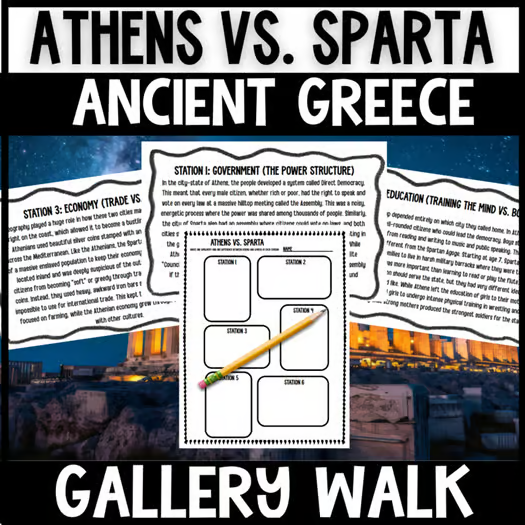
I’m biased because I created this one, but the Athens vs. Sparta Comparison Gallery Walk is my favorite way to pull the lesson together.
Students rotate through 6 stations covering government, education, economy, military, values, and social classes. Each station breaks the comparison into a manageable chunk, which is helpful because topics like direct democracy vs. oligarchy can get muddy fast.
By the end, students have a full recording sheet of evidence they can use for a debate, paragraph, essay, or review activity. It gets them moving, reading, and writing, which is usually much better than asking them to stare at one big chart for 30 minutes.
You can grab the Athens vs. Sparta Gallery Walk activity here.
Keep Ancient Greece alive
When students compare Athens and Sparta, I want them to see more than two columns of notes. These were real places with very different ideas about what mattered most.
Give students a chance to pitch, move, debate, read, and write. That variety helps them understand the difference between Athens and Sparta instead of just memorizing it for Friday.
Ready-to-use classroom resource
Want this social studies resource ready to print?
Save planning time with a classroom-ready activity built for upper elementary and middle school teachers.
This comparison lesson works well before teaching the Persian Wars or alongside Ancient Greece achievements.

