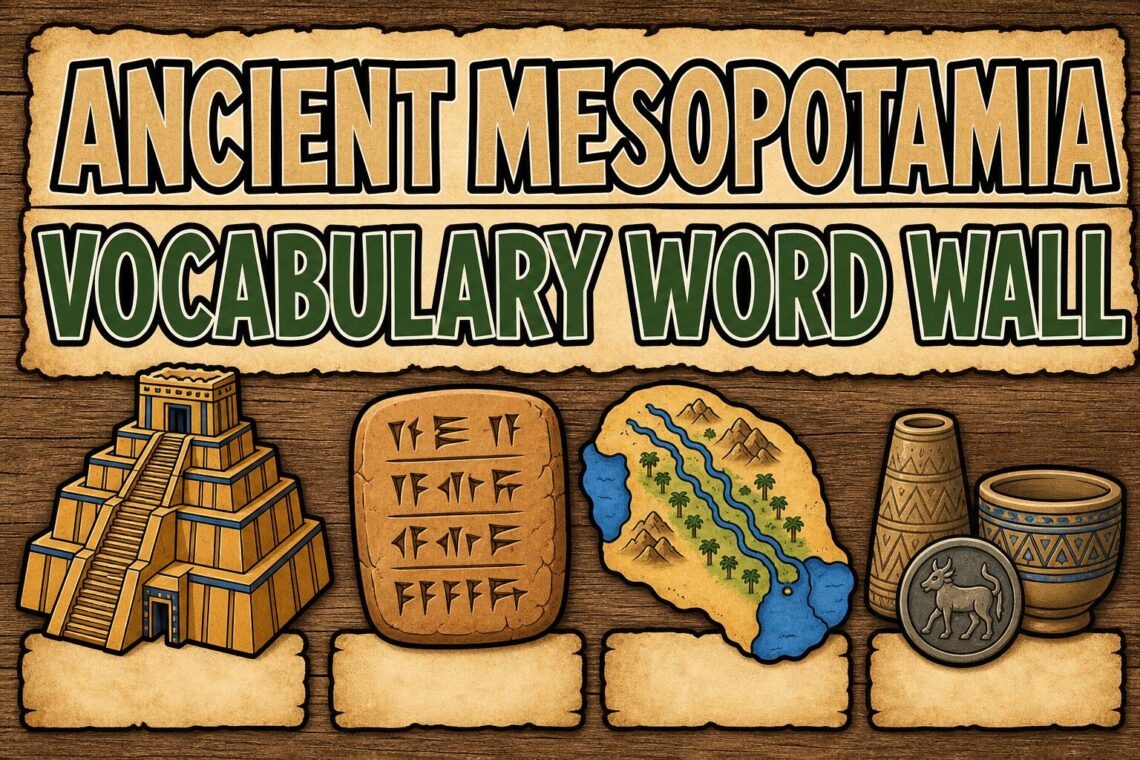
How to Teach Ancient Mesopotamia Vocabulary with a Word Wall
Ancient Mesopotamia vocabulary can feel like a lot for students at first. They are meeting new places, new inventions, new government systems, new religious ideas, and new words that do not sound like anything they use in everyday conversation.
\n\n\n\nThat is why I like using an Ancient Mesopotamia vocabulary word wall during the unit. It gives students a visual reference they can keep coming back to as they read, discuss, write, and review. Instead of treating vocabulary like a one-day list, the words stay visible and useful throughout the whole unit.
\n\n\n\nStart with the words students will actually use
\n\n\n\nA strong Mesopotamia word wall does not need every possible term from the unit. It works best when it focuses on the words students will see again and again. For a 6th grade ancient civilizations unit, that usually includes terms like Fertile Crescent, ziggurat, cuneiform, irrigation, city-states, polytheism, Hammurabi’s Code, monarchy, empire, and artisan.
\n\n\n\nThose words connect directly to the big ideas of the unit: geography, farming, government, religion, technology, and culture. When students understand the vocabulary, they have a much easier time explaining why Mesopotamia mattered.
\n\n\n\nMake vocabulary visual, not just verbal
\n\n\n\nMany Mesopotamia terms are easier to understand when students can picture them. A ziggurat makes more sense when students see the tiered structure. Cuneiform becomes more memorable when they connect it to clay tablets and wedge-shaped writing. Irrigation is easier to explain when students can see how canals helped move water from rivers to fields.
\n\n\n\nThat is the real value of a classroom word wall. It is not just decor. It is a reference tool. Students can look across the room during a discussion or writing task and quickly remind themselves what a word means.
\n\n\n\nUse the word wall during the lesson
\n\n\n\nIf the posters only go up on the wall and stay there, students may stop noticing them. I like building quick routines around the vocabulary so the word wall becomes part of the lesson.
\n\n\n\n- \n
- Before reading, preview three words students will need that day. \n
- During discussion, ask students to use one posted word in their answer. \n
- After a lesson, have students choose the word that best connects to the main idea. \n
- For review, ask students to group words by geography, government, religion, or technology. \n
- Before a writing task, have students pick two vocabulary words they must use correctly. \n
These small routines do not take much time, but they help vocabulary become something students actually use instead of something they copy once and forget.
\n\n\n\nConnect Mesopotamia vocabulary to bigger concepts
\n\n\n\nVocabulary is more powerful when students see how the words fit together. For example, Fertile Crescent, irrigation, and silt all connect to geography and farming. City-states, monarchy, empire, and Hammurabi’s Code connect to government and power. Ziggurat and polytheism connect to religion.
\n\n\n\nYou can turn that into a quick review activity by giving students a few categories and asking them to sort the vocabulary words. Then have them explain one connection. A student who can say, “Irrigation helped farmers use river water, which supported larger city-states,” is doing more than memorizing a definition.
\n\n\n\nIf you want another hands-on way to help students connect vocabulary with the big ideas of the unit, this Mesopotamia ziggurat project activity pairs especially well with vocabulary work because students build and explain one of the most important structures from ancient Mesopotamia.
\n\n\n\nA low-prep Ancient Mesopotamia word wall option
\n\n\n\nIf you want the vocabulary visuals already made, I created a set of Ancient Mesopotamia vocabulary posters for 6th and 7th grade social studies. Each poster includes a student-friendly definition and visual support for key terms from early civilizations, Sumer, Babylon, government, religion, farming, and Mesopotamian inventions.
\n\n\n\n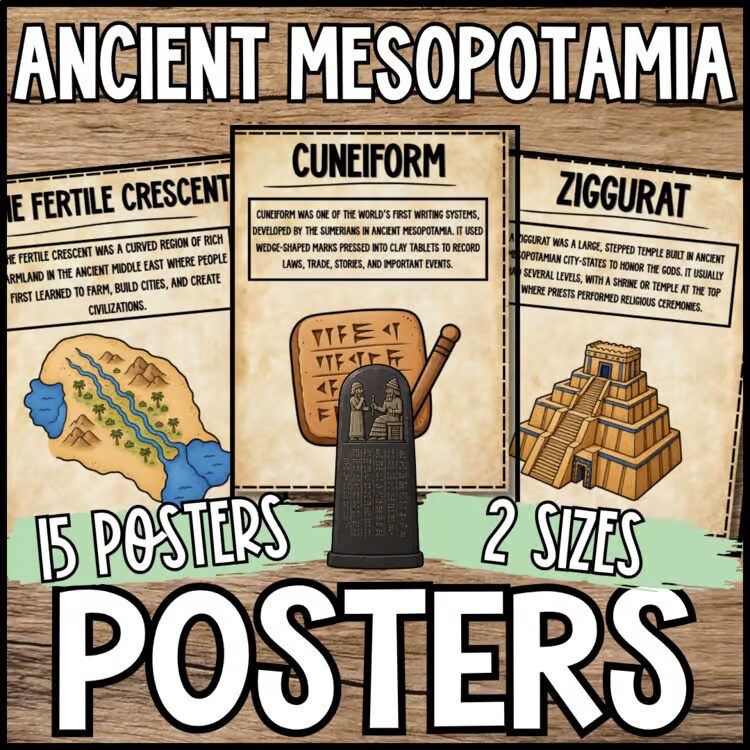
The set includes two sizes and two styles, so you can use them as a word wall, bulletin board display, classroom reference, vocabulary review tool, or unit support while students work through Ancient Mesopotamia.
\n\n\n\nFinal thought
\n\n\n\nAncient Mesopotamia has a lot of vocabulary, but students do not need to tackle it as a disconnected list. A visual word wall helps them revisit the same terms across reading, discussion, writing, and review. When the words stay visible and connected to the big ideas, students are more likely to remember them and use them correctly.
\nGrab free no-prep science & social studies resources
Get instant access to review templates, vocabulary posters, gallery walk samples, quick-check activities, and hands-on practice ideas for upper elementary and middle school.

Trey
Trey creates low-prep science, social studies, and ELA resources for upper elementary and middle school teachers through A Dad’s Classroom.