Middle School Social Studies Activities
Find social studies activities for ancient civilizations, American history, gallery walks, review games, and classroom discussion.
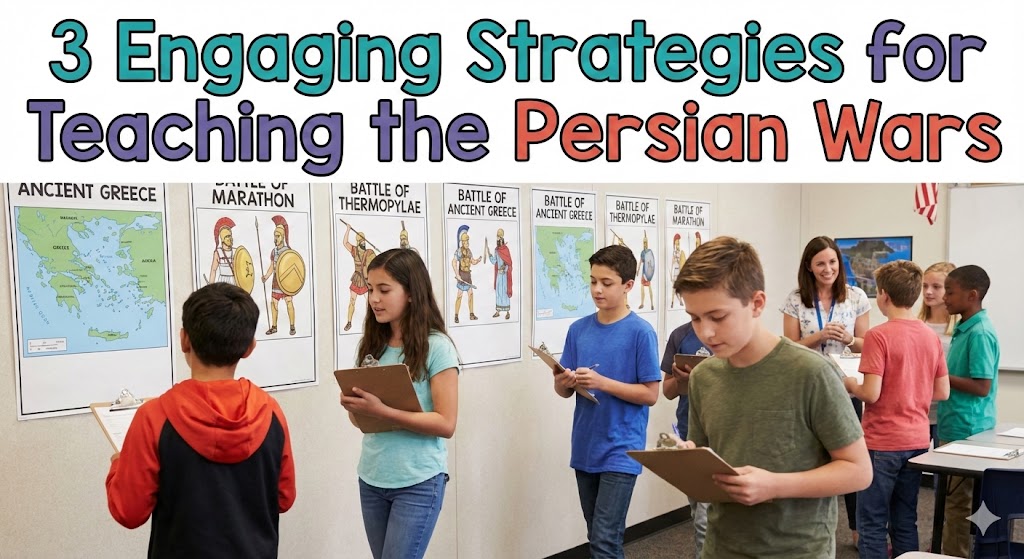
3 Engaging Strategies for Teaching the Persian Wars
The Persian Wars can either be really exciting or really confusing for students. Battles, city-states, leaders, invasions, maps—it can turn into a list of names quickly if we are not careful. I like teaching the Persian Wars as a story. Not a fake dramatic story, but the real one: Greek city-states with plenty of disagreements suddenly having to face a huge outside threat. That gives students a reason to care about Marathon, Thermopylae, Salamis, and why these battles mattered. Start with the big question Before getting into details, I like asking students why smaller groups might unite against a larger empire. What would make rivals cooperate? What would they risk…
A World of Faith: 3 Strategies for Teaching World Religions in Middle School
Teaching world religions takes some care. You want students to learn accurate information, ask thoughtful questions, and understand how religion has shaped history and culture, but you also want the classroom tone to stay respectful. For middle schoolers, I think structure helps a lot. If students know they are learning about origins, beliefs, practices, texts, holidays, and cultural influence, they are less likely to treat the unit like a random list of facts. Set the tone first Before we start, I like to remind students that the goal is understanding, not debating whose beliefs are “right.” We are studying world religions as part of history and culture. That simple framing…
3 Engaging People of the American Revolution Activities for Your Classroom
The American Revolution can turn into a long list of names really fast if we are not careful. Washington. Jefferson. Abigail Adams. King George III. Benedict Arnold. Students may recognize a few of them, but that does not always mean they understand why those people mattered. That is usually the real classroom problem with teaching the People of the American Revolution. The buy-in is there because spies, betrayal, protests, and war are interesting. But students need help seeing these figures as real people making hard choices, not just names to memorize for a quiz. My favorite fix is to build in variety. Get them moving, reading, talking, and using evidence.…
Unwrapping Ancient Egypt: 3 Engaging Activities to Teach the Mummification Process
Mummification is one of those Ancient Egypt topics where you do not have to work very hard to get attention. Say “they removed the brain through the nose,” and suddenly everyone is listening. The tricky part is moving past the gross factor. Students remember the weird details, but I also want them to understand the belief system behind the process. For Ancient Egyptians, mummification was connected to the afterlife, religion, preservation, and respect for the body. Here are three mummification process activities that keep the lesson interesting while still teaching the why behind the ritual. 1. Try the classic apple mummification experiment If you have a few days to let…
Athens vs. Sparta: 3 Engaging Activities to Bring Ancient Greece to Life
Athens vs. Sparta should be one of the most interesting parts of an Ancient Greece unit. The contrast is right there. Democracy and debate on one side. Military discipline and toughness on the other. But if we are not careful, it turns into a basic chart students copy and forget. Athens: education, arts, democracy. Sparta: military, strength, oligarchy. Done. Not exactly thrilling. I like teaching Athens vs. Sparta with activities that make students compare, defend, and actually use the differences between the two city-states. 1. Try a city-state real estate pitch This one is simple and usually gets some great student responses. Divide the class into two groups: one group…