Fun Ways to Teach Global and Local Winds in Middle School Science
Teaching global and local winds can feel a little abstract at first. Students hear terms like trade winds, westerlies, sea breeze, and land breeze, but those ideas do not always click until they can actually see the patterns and connect them to real-world movement in the atmosphere.
If you want your students to move beyond memorizing definitions, it helps to teach this topic in several different ways. Here are a few of my favorite strategies for making global and local winds more engaging and easier to understand in middle school science.
1. Start with a simple phenomenon students can picture
Before I ever hand out notes, I like to begin with something concrete. Ask students why a beach often feels cooler in the afternoon or why air moves differently over land and water. You can also show a quick weather map, satellite image, or even a short clip of wind in action.
This gives students a reason to care about the content before they learn the vocabulary. Instead of treating winds like isolated science terms, they begin to see them as patterns that affect real places and real weather.
2. Use visuals, diagrams, and map-based thinking
Global and local winds are much easier to understand when students can track movement with their eyes. I like using arrows, labeled diagrams, and simple maps so students can compare large-scale global wind belts with smaller local wind patterns.
When students can look at a diagram of Earth and trace where the polar easterlies, trade winds, and westerlies move, the content becomes much less intimidating. The same is true for local winds like land breezes and sea breezes. A quick visual comparison helps students notice what causes each pattern instead of just trying to memorize names.
If you teach this unit, I highly recommend giving students multiple chances to interpret visuals on their own. Ask questions like:
- What direction is the air moving?
- What is causing that movement?
- Is this a global pattern or a local pattern?
- How might this affect weather in a region?
3. Get students moving with a gallery walk
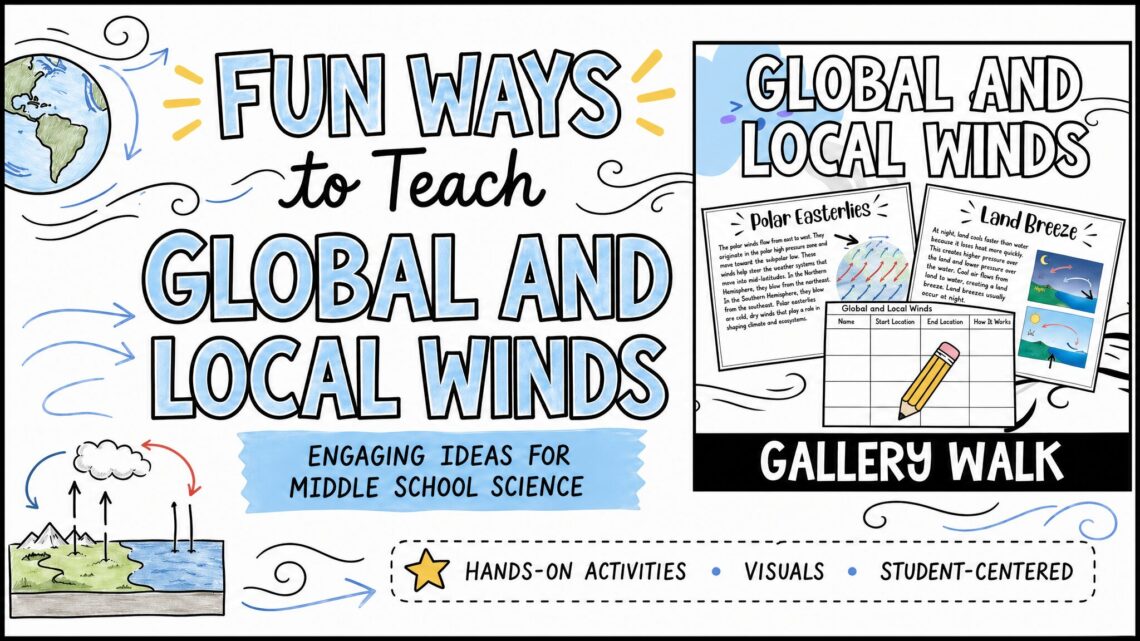
This is one of my favorite ways to teach global and local winds because it combines reading, movement, and repeated exposure to the key concepts. Instead of sitting through a long lecture, students rotate from station to station and interact with the content in smaller chunks.
One resource I use for this is my Global and Local Winds Gallery Walk | Earth Science Reading Stations Activity. It gives students a chance to work through different wind concepts in a format that feels more active and manageable.
What I like about a gallery walk is that it naturally breaks up the topic. Students can focus on one type of wind, one diagram, or one short reading at a time. That keeps the lesson from feeling overwhelming, especially for students who struggle with dense science text. It also gives you a built-in way to circulate, ask questions, and clear up misconceptions as students work.
4. Build in comparison practice
Students often mix up global and local winds because both topics involve moving air. That is why comparison work matters so much. After students have seen both types, I like to ask them to sort examples, complete a T-chart, or explain the difference in their own words.
You can have students compare:
- scale of movement
- causes of the wind pattern
- examples of each type
- how each one affects weather and climate
This is usually the point where the unit starts to click. Students realize that global winds are part of larger atmospheric circulation patterns, while local winds are tied more directly to temperature differences in a specific area.
5. End with writing or discussion that makes students explain the science
One of the best ways to check understanding is to ask students to explain why a wind pattern happens instead of just naming it. A short exit ticket, quick write, or partner discussion can tell you a lot.
Try prompts like:
- Why does a sea breeze happen during the day?
- How are global winds different from local winds?
- Which visual from today helped you understand the topic best, and why?
These kinds of questions push students to process the content more deeply and give you a better picture of what they actually understand.
Final thoughts
If you are looking for fun ways to teach global and local winds, the biggest key is variety. A strong lesson sequence gives students a concrete example, helpful visuals, active practice, and time to explain what they learned. When you combine those pieces, this topic feels much more approachable.
If you want a ready-to-use activity that gets students moving while reinforcing the content, check out my Global and Local Winds Gallery Walk. It is a simple way to add engagement while helping students build real understanding of the science.
Happy teaching!