Industrial Revolution Review Game Ideas for Big Kids
Industrial Revolution review can get a little tricky because the unit is packed with vocabulary, inventions, causes, effects, and big social changes. Students might remember the cotton gin one minute and then mix up urbanization, factories, and working conditions the next.
That is why I like giving students a review day that does more than ask them to stare at a study guide. They still need to retrieve the content, read carefully, and make choices. But if you can add movement, discussion, and a little friendly competition, the whole thing feels a lot less like “please memorize these terms before the test.”
Here are a few simple ways to make an Industrial Revolution review game work well for upper elementary or middle school social studies.
Start with the vocabulary students keep blending together
Before any game starts, I like to do a quick vocabulary reset. The Industrial Revolution has so many terms that sound familiar to students, but they do not always understand how they connect.
A fast warm-up can help. Put 5–6 words on the board and ask students to sort them into groups. For example:
- inventions and technology
- factory life and labor
- urbanization and cities
- causes and effects
- people or groups impacted by change
This does not have to take long. The point is to get students thinking before the review activity turns into a guessing game. I especially like asking, “Which two terms are connected, and how?” because it pushes them past matching definitions.
Use short questions so the review keeps moving
For a game-based review day, short questions are your friend. Multiple-choice questions, quick “which statement is true?” prompts, and cause-and-effect examples help students practice a lot of content without the lesson getting stuck.
An Industrial Revolution activity does not need to be complicated to be useful. Students can review inventions, child labor, factory conditions, urban growth, and transportation changes in small bites. Then you can pause after a question that students miss and talk through the reasoning.
My favorite rhythm is simple: answer, reveal, explain, move on. If the class needs more support, stop and fix the misconception. If they get it, keep the energy going.
Add movement, but keep the history thinking first
I’m biased toward review games that let students move a little, because big kids often need that reset. But the movement has to support the content. Otherwise, the room gets loud and the actual history disappears.
That is why Trashketball works nicely for social studies review. Students answer the Industrial Revolution question first. The basketball shot comes after the thinking. It gives them something to look forward to, but the review still stays centered on the content.
A few rules make it easier:
- Teams have to agree before answering.
- Students need to be ready to explain why an answer is correct.
- Only one person shoots at a time.
- The class has to be quiet enough to hear the next question.
Nothing fancy. Just enough structure so it feels like a classroom review game and not indoor recess with paper balls.
Mix facts with cause-and-effect questions
The Industrial Revolution is more than a list of inventions. Students need to understand how new machines, factories, transportation, and city growth changed people’s lives.
So as you review, mix in questions that ask students to think about cause and effect. For example:
- What changed when factories became more common?
- Why did people move from farms to cities?
- How did new technology affect production?
- What were some negative effects of industrialization?
These questions make a social studies review activity feel more useful because students are not just recalling one-word answers. They are practicing the relationships that usually show up on quizzes, tests, and class discussions.
Try a ready-to-use Industrial Revolution Trashketball game
If you want the review already built, I created this Industrial Revolution Trashketball Review Game for upper elementary and middle school social studies.
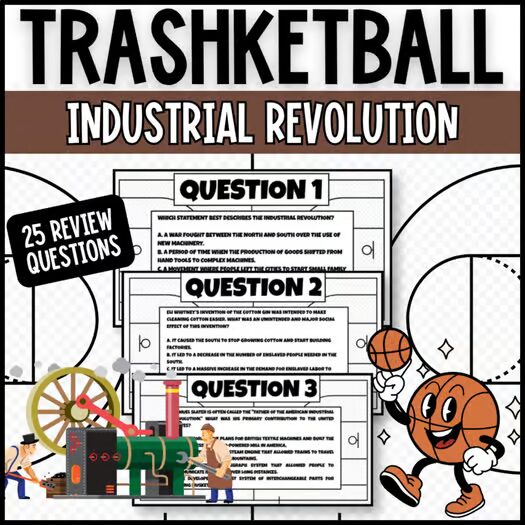
It includes 25 multiple-choice review questions with answer slides, so students can practice Industrial Revolution vocabulary, causes, effects, inventions, and big-picture ideas in a game format. The slideshow is presentable and editable in Canva, which is helpful if you want to adjust a question or match it more closely to your unit.
I like this kind of review for end-of-unit practice, test prep, or those days when students need to retrieve a lot of social studies content but you do not want to hand them another quiet worksheet.
End with one written takeaway
After the game, I still like ending with a short written response. It gives students a calm landing spot and gives you a quick check for understanding.
You could ask:
- What was one major effect of the Industrial Revolution?
- Which invention or change had the biggest impact? Explain.
- What is one term you understand better now?
- What question would you still want to review before the test?
It only takes a few minutes, but it helps the activity turn into real retrieval practice instead of just a fun game. And honestly, that is the sweet spot: students reading, moving, thinking, discussing, and remembering a little more than they did when they walked in.
Grab free no-prep science & social studies resources
Get instant access to review templates, vocabulary posters, gallery walk samples, quick-check activities, and hands-on practice ideas for upper elementary and middle school.