3 Engaging People of the American Revolution Activities for Your Classroom
History is so much more than just a timeline of battles and dates. It’s about the people—the spies, the generals, the writers, and the rebels who risked everything for what they believed in.
But let’s be honest: when we stare at a textbook page listed with names like “George Cornwallis” or “Benedict Arnold,” our students’ eyes can sometimes glaze over. They struggle to connect with these figures as real human beings with complex motivations.
So, how do we turn these historical figures into three-dimensional characters that our students actually care about?
If you are looking to spice up your social studies block, here are three of my favorite strategies to teach the People of the American Revolution!
1. The “Heroes & Villains” Gallery Walk
This is my absolute favorite way to introduce or review the key players of the war. Instead of a lecture or a slideshow, I want my students acting as historians, moving around the room and gathering evidence.
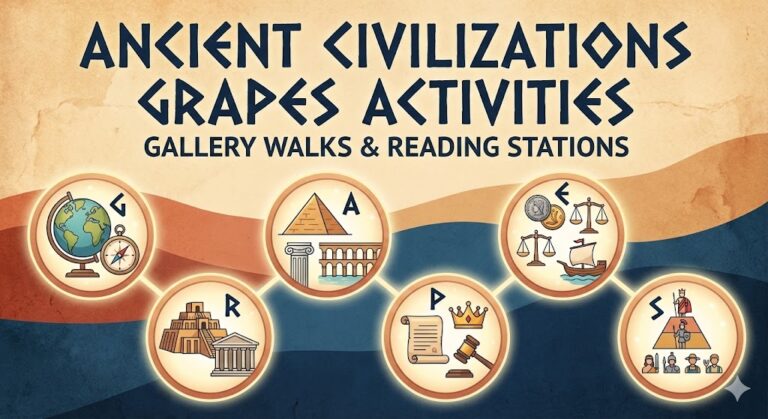
I recently started using this People of the American Revolution Gallery Walk, and it has been a lifesaver for this unit.

Here is why it works: It transforms your classroom into a museum hall. Students rotate through stations featuring 11 key figures, including George Washington, Abigail Adams, Thomas Jefferson, and even King George III.
At each station, they read a short, engaging passage that covers:
- Allegiance: Were they a Patriot or a Loyalist?
- Role: What did they actually do to impact the war?
- Fun Facts: Little details that spark curiosity.
It is completely no-prep for you—just print and tape! By the time they finish their recording sheet, they haven’t just memorized names; they’ve analyzed the diverse cast of characters that built (or tried to stop) our nation.
You can grab the People of the American Revolution Gallery Walk here!
2. The “Patriot vs. Loyalist” Coffee Shop Debate
Once students know who the people are, it’s time to understand why they chose their sides.
The Activity: Assign each student a specific historical figure (e.g., Patrick Henry vs. a wealthy British merchant). Set the scene: It’s 1776, and they are meeting in a colonial coffee shop (or tavern) to discuss the “trouble brewing” in the colonies.
Students have to stay in character and debate the latest news (like the Boston Tea Party or the Declaration of Independence) from their figure’s perspective. It forces them to think critically about the motivations behind the names on the page.
3. The “Spy Code” Challenge
You can’t talk about the people of the revolution without mentioning the spies! Middle schoolers are obsessed with the Culper Ring.
The Activity: Give students a “secret message” written in a simple substitution cipher (or use the actual Culper Code book numbers if you want to be authentic!). Tell them it is an intercepted letter from Benedict Arnold or a warning from Paul Revere.
Their job is to decode the message to reveal a fact about a key historical figure. It’s a fun, high-engagement way to highlight the daring individuals who operated in the shadows.
Making History Human
Whether they are decoding secret messages, debating in a coffee shop, or walking through a gallery of heroes, the goal is the same: to help students see that the American Revolution was driven by real people making difficult choices.