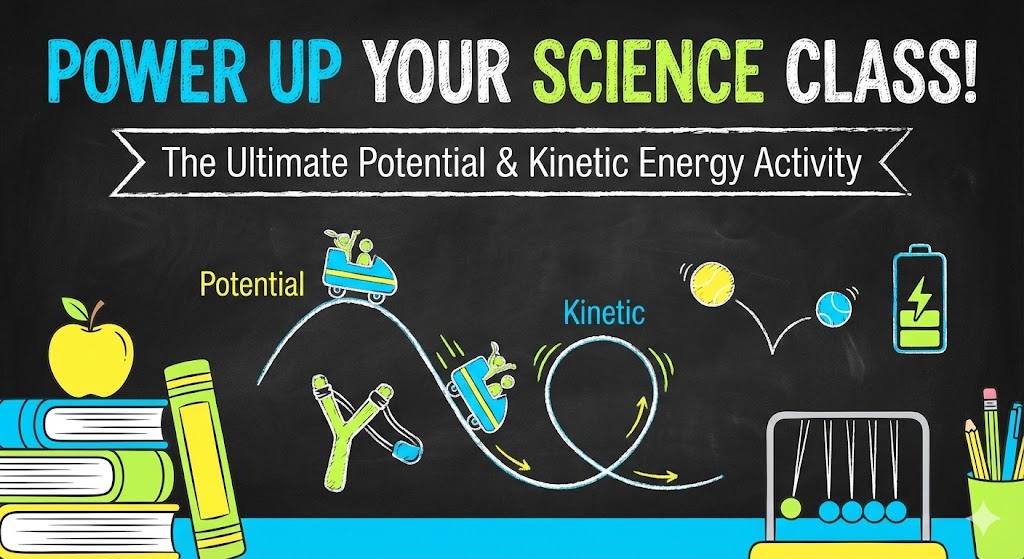
The Ultimate Potential and Kinetic Energy Activity to Get Students Moving
Let’s be real for a second: Teaching energy can be tough. It’s one of those invisible concepts that students often struggle to grasp because they can’t just reach out and touch it. We talk about “stored energy” and “energy in motion,” but unless we make it concrete, it just sounds like vocabulary words floating in the air.
How do we take something as abstract as the Law of Conservation of Energy and make it stick? How do we help students actually visualize the flow from potential to kinetic and back again?
If you are looking for ways to spark some excitement in your science block, here are three of my favorite strategies for teaching energy transfer!
1. The Energy Transfer Gallery Walk
This is my number one strategy because it solves the biggest problem with teaching this unit: reading comprehension. Often, students can define “potential” and “kinetic,” but they struggle to identify them in real-world scenarios.
I recently started using this Energy Transfer Gallery Walk, and it is a total game-changer.

Here is why it works: Instead of a dry worksheet, this potential and kinetic energy activity gets students out of their seats and moving (pun intended!). They rotate through different stations that feature real-life scenarios—like a roller coaster at the top of a hill or a stretched rubber band.
For each station, they read a short passage and have to:
- Identify the specific types of energy involved (Gravitational Potential, Elastic Potential, Thermal, Chemical, etc.).
- Diagram the flow of energy transformation.
It is student-led, completely no-prep for you (just print and tape!), and it forces them to think critically about how energy changes forms. Plus, it covers all the major types, including sound, light, and electrical energy.
You can grab the Energy Transfer Gallery Walk here!
2. The “Rubber Band Racer” Challenge
Once they understand the basics, I love giving them a design challenge to see Elastic Potential Energy in action.
The Challenge: Give students simple materials: two CDs (for wheels), a cardboard tube, a wooden skewer, and a rubber band. Their goal is to build a car that travels the furthest distance.
The “Aha!” moment comes when they wind up the rubber band. They can physically feel the tension building up (Potential Energy). When they let go, they watch that stored energy instantly transform into motion (Kinetic Energy). It’s a fantastic, hands-on engineering challenge that reinforces the concept perfectly.
3. The Pendulum Bowling Experiment
This is a classic for a reason. To demonstrate Gravitational Potential Energy, set up a simple pendulum using a string and a heavy washer or ball.
Set up a “bowling pin” (a marker or an empty water bottle) at the bottom of the swing path. Have students release the pendulum from different heights.
- Low Height: The pendulum might not have enough energy to knock the pin over.
- High Height: The pendulum smashes into the pin!
It’s a simple, visual way to prove that the higher the object, the more Gravitational Potential Energy it has to convert into Kinetic Energy.
Keeping the Energy High
Whether you are building racers, swinging pendulums, or doing a deep-dive gallery walk, the goal is to make energy visible. When students can see the transfer happen right in front of their eyes, the science suddenly makes sense.