Project Hail Mary Novel Study Activities for Middle and High School ELA
Some novels are easy to assign and hard to actually teach well. Project Hail Mary is one of those books that students can get really into, but it also asks a lot from them. There is science, problem solving, memory, survival, friendship, and plenty of moments where students need to slow down and think instead of just turning pages.
That is why I like having a clear Project Hail Mary novel study plan before starting. Not a giant binder of busywork. Just enough structure to keep students reading, writing, discussing, and checking their understanding as they move through the book.
Start with curiosity before chapter questions
Before students ever get deep into the novel, I like giving them something that gets them wondering. An anticipation guide, a quick discussion, or a few “what would you do?” questions can help students step into the survival-and-science side of the story before the plot gets complicated.
This does not need to be fancy. The goal is to make students curious enough to care. Project Hail Mary gives you a lot to work with: isolation, problem solving, communication, risk, and the question of how far someone should go to save others.
Use chapter questions to keep students accountable
I know chapter questions can get a bad reputation, and honestly, they deserve it when they turn into a never-ending packet of “find this tiny detail.” But used well, novel study questions can be really helpful.
For this book, I would keep questions focused on comprehension, character decisions, problem solving, and text evidence. Students need enough support to follow what is happening, especially with the science fiction pieces, but they also need room to explain their thinking.
My favorite questions are the ones that make students go back into the chapter and retrieve something important. Having students crawl back into their memory often is so necessary, especially with a novel that has reveals and shifting timelines.
Make the science fiction feel readable
One thing I really like about teaching this book is that it gives ELA teachers a natural way to talk about science fiction without turning the class into a science lesson. Students can look at how Andy Weir builds tension, explains technical ideas, and keeps the human part of the story moving.
If your students struggle with science fiction reading comprehension, try pausing for quick “what do we know so far?” check-ins. Let students name the problem, the attempted solution, and what changed. That little routine can keep the plot from feeling like a blur.
Build in discussion before the final assignment
Project Hail Mary has plenty of moments that are better after students talk them out. A quick partner discussion, small-group question, or Socratic seminar can help students process the bigger ideas before they write about them.
I especially like discussion for character motivation and theme. Students may notice the science first, but the friendships, choices, and sacrifices are what usually stick with them.
Try this Project Hail Mary novel study resource
If you want the structure already built, I made this Project Hail Mary Novel Study for grades 6–10 ELA.
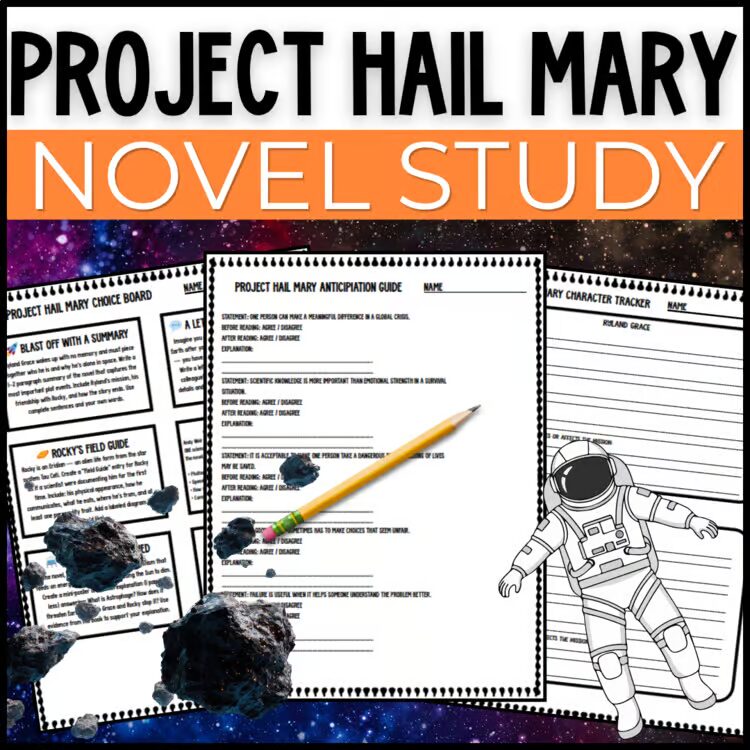
It includes an anticipation guide, vocabulary activities, chapter-by-chapter reading comprehension questions, a character analysis tracker, writing prompts, discussion and Socratic seminar questions, a creative project, and a 25-question final test with an answer key.
I’m biased because I created it, but I like having all of those pieces in one place. It makes the unit easier to pace, and it gives students different ways to show understanding instead of doing the same type of response every single day.
The activities are editable in Canva too, so you can adjust questions, shorten the unit, add your own emphasis, or make it fit the way your class is reading the novel.
Give students more than one way to respond
For middle school ELA and high school ELA, I like mixing the response types. Some days students answer comprehension questions. Some days they track a character. Some days they discuss. Some days they write a longer response or work on a creative task.
That variety matters. It keeps the novel study from feeling like a packet, and it gives students more chances to show what they actually understand.
End with a final check that feels fair
A final test or culminating writing task works best when it matches what students have been doing the whole time. If students have been reading closely, discussing decisions, tracking characters, and explaining evidence, the final assessment should feel like a natural extension of that work.
That is the sweet spot for a Project Hail Mary novel study: enough structure that students stay grounded, enough variety that they stay interested, and enough room for them to think through why this story works.
If your class is heading into Andy Weir’s novel, a little planning up front can make the whole unit feel smoother. Get them reading, writing, discussing, and retrieving often, and the book becomes much easier to manage.
Grab free no-prep science & social studies resources
Get instant access to review templates, vocabulary posters, gallery walk samples, quick-check activities, and hands-on practice ideas for upper elementary and middle school.