
4 Engaging Ways to Teach Ancient Greece Achievements
Ancient Greece achievements are some of my favorite topics to teach because students can still see their influence everywhere: government, sports, theater, architecture, math, history, and big philosophical questions. The tricky part is helping students understand those contributions without turning the lesson into a long list of facts.
If you teach 6th grade social studies, ancient history, or world history, these four strategies can help make your Ancient Greece unit more active, memorable, and student-friendly.
1. Start with a “Where Do We Still See This?” Warm-Up
Before students read anything, give them a quick connection challenge. Show a few modern examples connected to Greek achievements: a courthouse with columns, the Olympic rings, a theater stage, a voting symbol, or a geometry diagram. Ask students to predict how each one might connect back to Ancient Greece.
This makes the lesson feel relevant right away. Instead of asking students to memorize Greek contributions, you are helping them notice that Ancient Greece shaped ideas and systems they still recognize today.
2. Use Movement with an Ancient Greece Gallery Walk
A gallery walk is a simple way to turn Ancient Greece achievements into an active lesson. Instead of sitting through notes, students rotate around the room, read short station passages, and record the key details on a worksheet or graphic organizer.
For this topic, I like stations that focus on major Greek contributions such as democracy, philosophy, theater, the Olympic Games, geometry, historical writing, and classical architecture. These topics work especially well as reading stations because each achievement is distinct, but together they help students see the larger impact of Greek civilization.
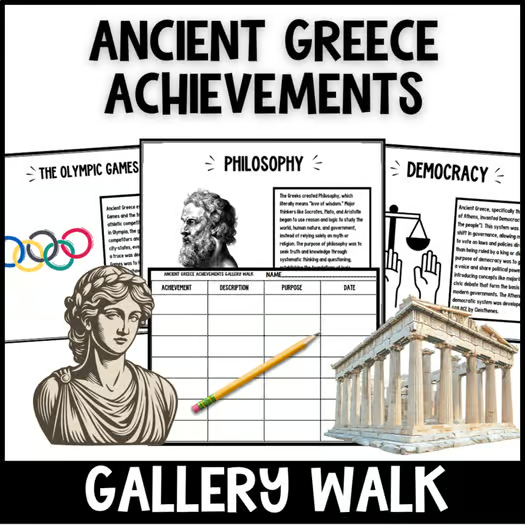
If you want a ready-to-use option, this free Ancient Greece Achievements Gallery Walk gives students printable reading stations, a recording sheet, and an answer key. It is a no-prep Ancient Greece activity that works well for introducing the topic, reviewing before an assessment, or adding movement to a world history lesson.
3. Have Students Rank the Most Influential Achievement
After students learn about the major achievements, ask them to rank which one had the greatest long-term impact. You can have students choose from categories like democracy, philosophy, theater, the Olympics, architecture, geometry, or historical writing.
This turns the lesson into a discussion instead of a recall activity. Students have to explain their reasoning, use evidence from the reading, and compare achievements across categories. It also helps them understand that historical significance is something people can debate.
4. Connect Each Achievement to a Mini-Exit Ticket
To wrap up, give students a short exit ticket that asks them to connect one Greek achievement to the modern world. A few easy prompts are:
- Which Ancient Greece achievement do you think affects your life the most today?
- Which Greek contribution surprised you the most?
- Choose one achievement and explain its purpose in your own words.
- How did Ancient Greece influence government, culture, or learning?
These quick responses are great for checking understanding without needing a full worksheet. They also give students one more chance to make the content personal and meaningful.
Make Ancient Greece Achievements More Active
Ancient Greece achievements do not have to feel like a lecture-heavy list. With visuals, movement, discussion, and a clear recording task, students can explore the major contributions of Greek civilization in a way that feels organized and engaging.
If you need a simple place to start, grab the free Ancient Greece Achievements Gallery Walk reading stations activity and let students move, read, and connect the ancient world to the modern one.
Ready-to-use classroom resource
Want this social studies resource ready to print?
Save planning time with a classroom-ready activity built for upper elementary and middle school teachers.
View the resource
