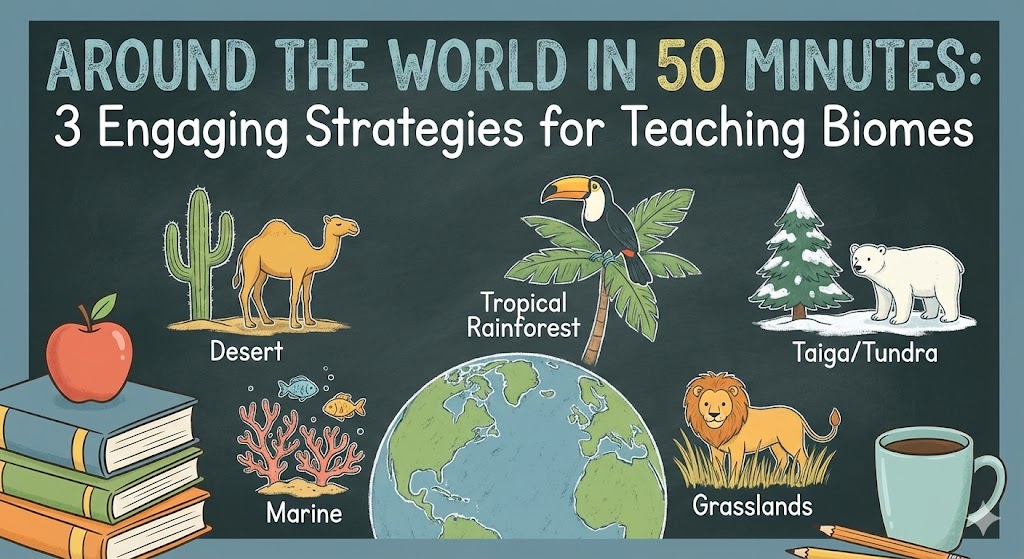
Around the World in 50 Minutes: 3 Engaging Strategies for Teaching Biomes
One of the best things about teaching science is the ability to transport your students to places they may have never seen before. One minute you are in a chilly, air-conditioned classroom, and the next, you are trekking through the humid Amazon rainforest or shivering on the frozen tundra.
But how do we make those diverse ecosystems feel real? How do we move beyond just memorizing temperatures and precipitation charts to really understanding the life that thrives there?
If you are ready to take your students on a global expedition, here are three of my favorite strategies for teaching biomes!
1. The Earth’s Biomes Gallery Walk
This is my go-to strategy for introducing the unit because it covers so much ground (literally!) in a short amount of time. Instead of a slideshow where students passively take notes, I want them to be active explorers.
I recently started using this Earth’s Biomes Gallery Walk, and it has been a game-changer for my science block.
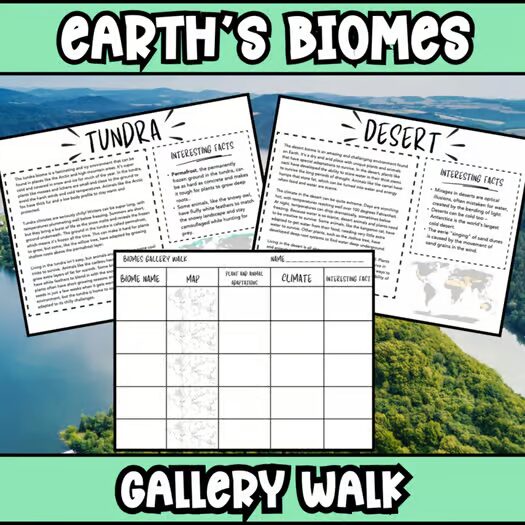
Here is why it works: It creates an immersive “museum” experience right in your classroom. Students rotate through stations representing the major biomes: Temperate Forest, Tropical Rainforest, Desert, Grasslands, Taiga, Tundra, Marine, Freshwater, and Coral Reef.
At each station, they read a concise passage that details:
- Climate: What is the weather like?
- Adaptations: How do plants and animals survive there?
- Location: Where in the world is this place?
It is completely no-prep for you (just print and tape!), and it encourages students to be independent researchers. By the time they finish their recording sheet, they have a comprehensive guide to the world’s ecosystems.
You can grab the Earth’s Biomes Gallery Walk here!
2. The “Shoebox Biome” Diorama
This is a classic project, but it never gets old. Once students have researched the biomes (perhaps using the Gallery Walk above!), assign each student or group a specific biome to build.
The Twist: Don’t just have them put plastic animals in a box. Challenge them to label specific adaptations.
- If they put a cactus in their Desert box, they need a label explaining why it has spines instead of leaves.
- If they put a polar bear in the Tundra, they need to explain the function of its blubber.
It turns an arts-and-crafts project into a rigorous demonstration of scientific understanding.
3. “Travel Agent” Brochures
This is a fun way to integrate writing into your science lesson. Tell your students they have been hired as travel agents for “Extreme Eco-Tours.”
Their job is to create a persuasive brochure convincing tourists to visit a specific biome. They need to include:
- “What to Pack”: (e.g., “Bring heavy coats for the Tundra!”)
- “What You’ll See”: Highlight the unique flora and fauna.
- “Activities”: (e.g., “Go snorkeling in the Coral Reef!”)
It forces them to think about the climate and environment in a practical, real-world way.
exploring Our Planet
Whether you are building shoebox worlds, designing travel brochures, or walking through a gallery of ecosystems, the goal is to help students appreciate the incredible diversity of our planet.