Teaching Infectious Agents with a Gallery Walk Activity
Infectious agents are one of those science topics where students usually have some background knowledge, but it can be a little messy. They know germs make people sick. They have heard of bacteria and viruses. They may even have strong opinions about hand sanitizer. But when you ask them to explain the difference between viruses, bacteria, fungi, and parasites, things can get fuzzy fast.
That is why I like using an infectious agents gallery walk for this topic. It gives students a way to read short chunks of information, move around the room, and organize the details without turning the whole lesson into one long lecture.
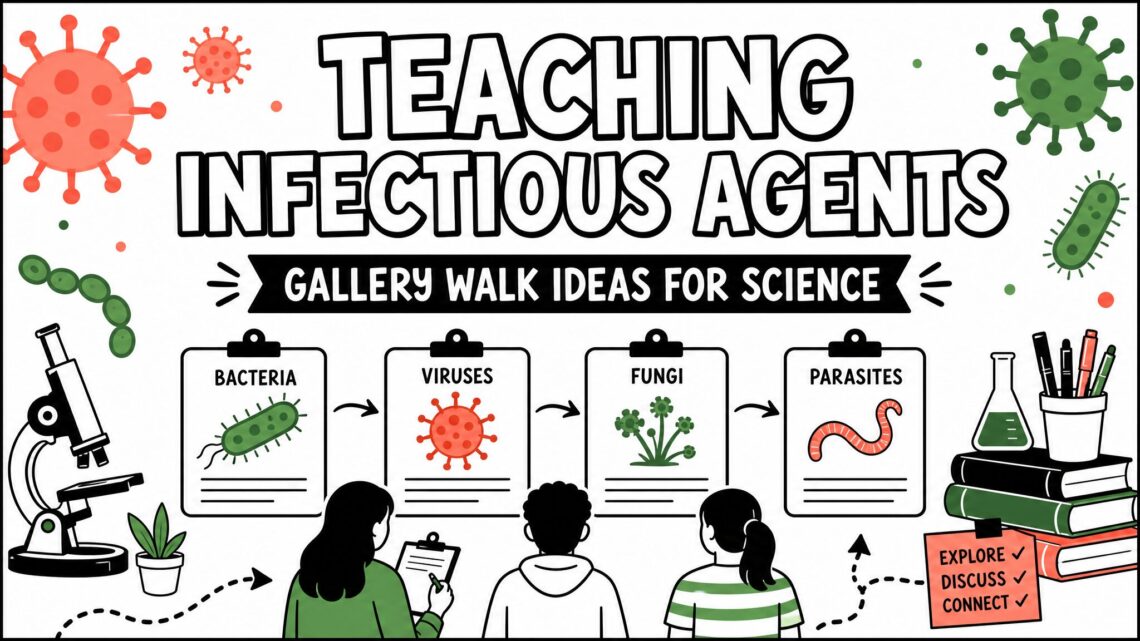
Start with the four main infectious agents
For upper elementary and middle school science, I would keep the focus tight at first. Students do not need a college-level microbiology lesson to understand the big idea. They need clear examples and a simple way to compare the agents that can cause disease.
The four categories I like to start with are:
- Viruses
- Bacteria
- Fungi
- Parasites
This gives students a strong base for later conversations about prevention, symptoms, immune response, public health, or body systems. It also makes the lesson feel doable. They are not trying to memorize every possible pathogen. They are learning the main groups and how they are different.
Use short reading stations so students actually read
My favorite way to teach infectious agents is with short reading stations. A full-page article can be fine, but a station format feels less overwhelming. Students read one focused piece, pull out a few important details, and then move to the next one.
For a science gallery walk, I like each station to answer the same basic questions:
- What is this infectious agent?
- What is one example?
- Where can it infect the body?
- What symptoms or effects can it cause?
- What is one interesting fact?
That repeated structure helps a lot. Students know what they are looking for, so they can spend more energy understanding the science instead of figuring out a new task at every stop.
Let students compare bacteria and viruses early
If students only remember one comparison from the lesson, I want it to be bacteria and viruses. Those two get mixed up constantly, and honestly, I get why. They are both tiny, both connected to sickness, and both get lumped together under “germs” in everyday conversation.
A simple compare-and-contrast moment can help. After students visit the bacteria and virus stations, pause and ask:
- How are bacteria and viruses alike?
- How are they different?
- Which one is a living organism?
- Why would treatment or prevention look different?
You do not need to turn this into a huge assignment. Even a quick partner talk or a two-column chart can make the bacteria and viruses piece stick better.
Add movement, but keep the expectations simple
I am very biased toward lessons that get students moving, reading, and writing. Movement helps break up the class period, especially with science vocabulary-heavy topics like pathogens and microorganisms.
But gallery walks work best when the routines are boringly clear. I usually like:
- Small groups or partners
- A starting station for each group
- A timer for rotations
- One answer sheet that students complete as they go
- A quick reset if the room starts getting too chatty
Nothing about that is fancy, but it keeps the room from turning into free-range wandering. Students still get movement, but the task stays academic.
Try a ready-to-use infectious agents gallery walk
If you want the station work already made, I created this Infectious Agents Gallery Walk for grades 4-8 science and health science classes.
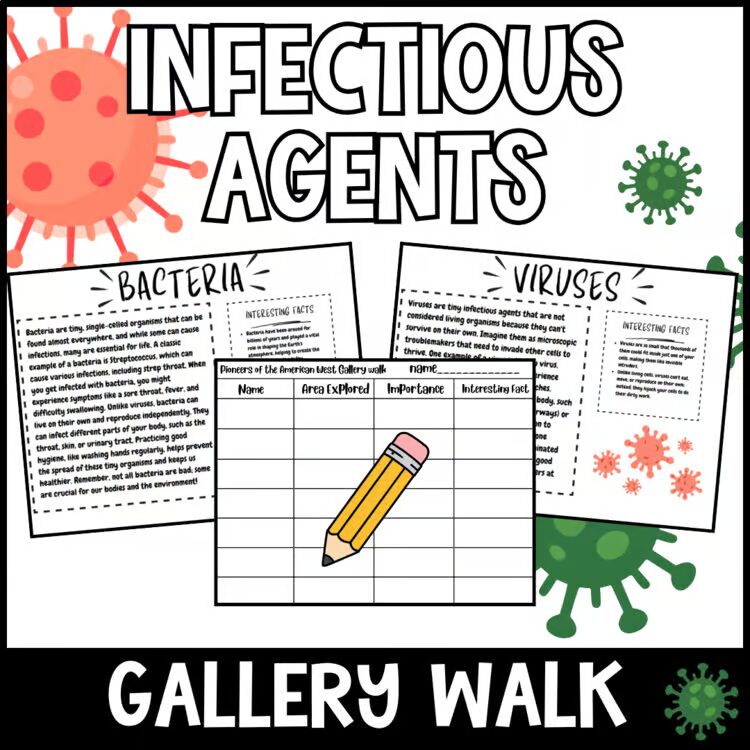
It includes stations for viruses, bacteria, fungi, and parasites, with short reading passages and an answer sheet for students to complete as they rotate. I’m biased because I made it, but this is exactly the kind of microorganisms activity I like for a busy science day: students are reading, moving, looking for specific information, and writing enough that you can see what they understood.
It is also a nice option when you want to add more reading to your science block without handing students a giant article and hoping for the best.
End with a quick retrieval question
After the gallery walk, give students one small retrieval task before you move on. It does not have to be long.
You might ask:
- Which infectious agent was easiest to understand? Why?
- Which one surprised you the most?
- How would you explain the difference between bacteria and viruses to a younger student?
- Which infectious agent do you think people misunderstand the most?
That last step matters because it asks students to pull the information back out of their brains. A simple retrieval question can make the whole infectious agents activity feel more complete.
The goal is not to make the lesson complicated. Give students clear information, let them move with a purpose, and help them compare the big categories. That is usually enough to make infectious agents click.
Grab free no-prep science & social studies resources
Get instant access to review templates, vocabulary posters, gallery walk samples, quick-check activities, and hands-on practice ideas for upper elementary and middle school.