A World of Faith: 3 Strategies for Teaching World Religions in Middle School
Let’s be honest: Teaching the history and beliefs of major world religions can be a little intimidating. You want to be respectful, accurate, and engaging, all while helping students understand complex belief systems that have shaped human history for thousands of years.
How do we move beyond just memorizing a list of holidays or deities? How do we help students see the connections between culture, geography, and faith without getting bogged down in too much text?
If you are looking for ways to make this unit accessible and meaningful for your students, here are three of my favorite strategies for teaching world religions!
1. The Major World Religions Gallery Walk
This is my absolute favorite way to introduce this unit. Instead of a long lecture where students might tune out, I love getting them out of their seats to “visit” each faith.
I recently started using this Major World Religions Gallery Walk, and it has been a total lifesaver.
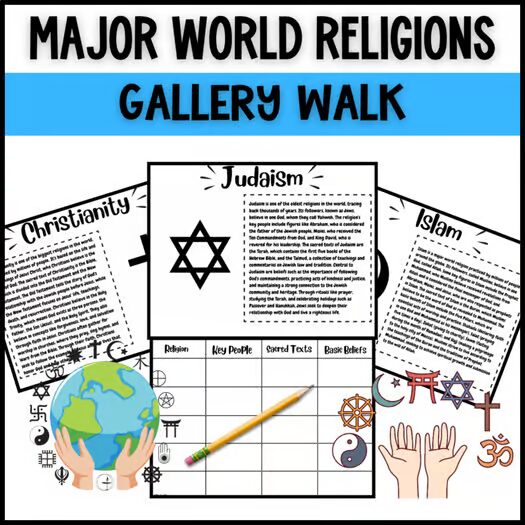
Here is why it works: It transforms the classroom into a global tour. Students rotate through 5 different stations, each dedicated to one of the major faiths: Judaism, Hinduism, Christianity, Islam, and Buddhism.
At each station, they read a concise, informative passage that covers the essentials:
- Description: What is the core essence of this faith?
- Major People: Who are the founders, prophets, or key figures?
- Sacred Texts: What books do they hold holy?
- Basic Beliefs: What are the fundamental principles?
It is completely no-prep (just print and go!), and it gives students a structured way to compare and contrast the different religions side-by-side on their recording sheet. It builds that crucial background knowledge they need before diving deeper.
You can grab the Major World Religions Gallery Walk here!
2. The “Artifact Inquiry” Box
To make religion feel real and tangible, I love using “Artifact Boxes” (or even just printed pictures if you don’t have physical items).
The Setup: Place a few items related to a specific religion in a box or at a station. For example:
- Buddhism: A lotus flower picture, a small statue, a singing bowl.
- Judaism: A dreidel, a picture of a Torah scroll, a menorah.
The Task: Have students examine the objects before they know which religion they belong to. Ask them: “What do these objects tell you about what these people value? Is this religion focused on nature? Text? Ritual?” It’s a fantastic way to build inquiry skills and spark curiosity.
3. “Common Threads” Venn Diagrams
Once students have the basics down (maybe after doing the Gallery Walk!), challenge them to find the similarities. We often focus so much on how religions are different that we forget to show how they are alike.
Create large Venn Diagrams on the floor using hula hoops or tape. Assign groups to compare two specific religions (e.g., Islam and Christianity, or Hinduism and Buddhism).
- The Challenge: Find at least three things they have in common (e.g., “Both believe in an afterlife,” “Both have a holy book,” “Both emphasize charity”).
- It leads to powerful discussions about the shared human desire for meaning and connection.
Building Understanding
Whether you are examining artifacts, comparing Venn diagrams, or walking through a gallery of beliefs, the goal is to build respect and understanding. When students can see the beauty and complexity in different traditions, they become more empathetic global citizens.