
A Fun Weather Instruments Review Game for Teaching Weather Tools
Weather instruments are one of those topics students think they know until the review questions start mixing together. Thermometer? Easy. Barometer, hygrometer, anemometer, and wind vane? That is where some students start guessing.
A weather instruments review game is a fun way to get one more round of practice in before a quiz or unit test. Students need quick retrieval, repeated vocabulary, and a reason to care just a little more than they would with another worksheet.
Start with fast weather tools vocabulary checks
Before jumping into a bigger game, I like to warm students up with the basic weather tools: thermometer, barometer, rain gauge, anemometer, wind vane, and hygrometer. Keep the questions quick. “Which tool measures wind speed?” “Which tool measures air pressure?” “What would we use to measure rainfall?”
It only takes a few minutes, but it shows you right away which tools need one more explanation before the game starts.
Turn review into movement with Trashketball
Trashketball is one of my favorite review formats because it adds energy without getting too complicated. Students answer a question, talk through their reasoning, and then get the fun part: a shot for points.
The important thing is keeping the science first. Students should be reviewing what each instrument measures and how meteorologists use weather tools, not spending half the class trying to understand the rules of the game.
Use a ready-to-go weather instruments review game
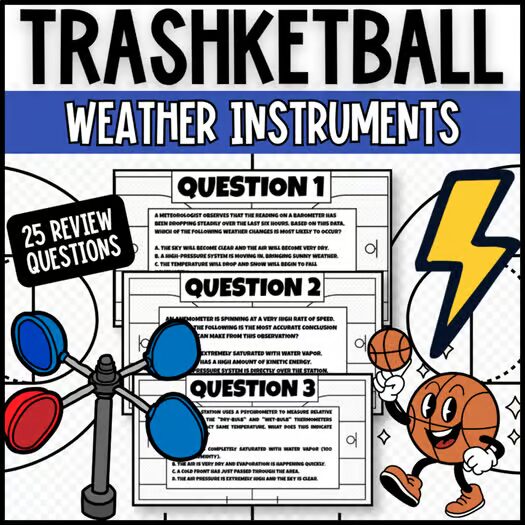
If you want the game already built, this Weather Instruments Trashketball Review Game includes 25 multiple-choice question slides, answer slides, and an answer key. It works well for upper elementary or middle school science when you need weather tools review, test prep, or an end-of-unit activity.
Keep teams small enough that everyone thinks
Large teams can be fun, but they also make it easy for a few students to disappear. Pairs or groups of three usually work best. Everyone has to talk, everyone has to commit to an answer, and nobody can hide behind the loudest person in the group.
One tiny accountability trick: have students write the weather instrument and what it measures before they answer. It keeps the game academic while still letting it feel like a game.
End with a quick confidence check
After the game, ask students to name one weather tool they feel great about and one they still need to review. That exit ticket gives you useful information, and it helps students realize the goal was not just to play. It was to remember.
A good weather instruments review game gives students movement, retrieval, and a little fun at the exact moment they usually need it most. That is a pretty solid review day.

