
Teaching Levels of Organization Without Overwhelming Your Students
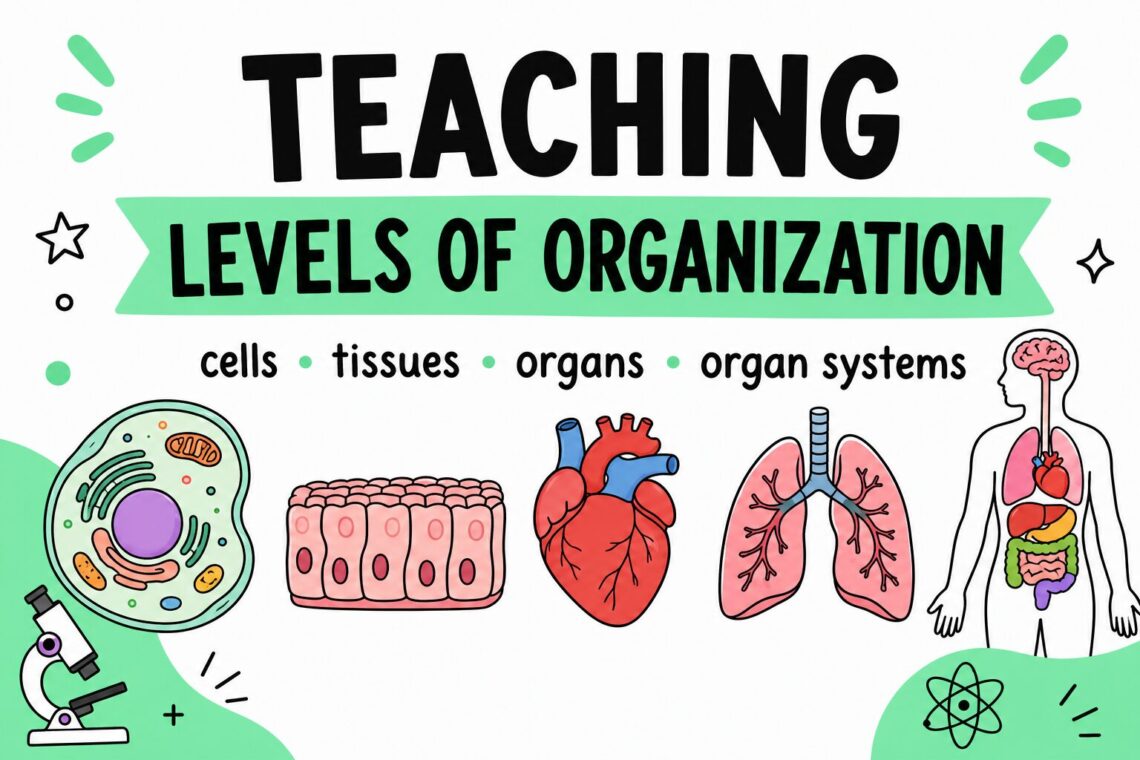
Teaching levels of organization can feel simple on paper—cells, tissues, organs, organ systems—but students often need more than a quick definition list before the hierarchy really clicks. They have to see how each level builds on the one before it, and they need enough examples to connect the vocabulary to actual living things.
If your middle school science students mix up tissues and organs, or they can recite the order without explaining what it means, these low-prep ideas can help make the biological hierarchy feel more concrete.
Start with a quick “build the hierarchy” warm-up
Before jumping into notes, give students the four terms—cell, tissue, organ, and organ system—and ask them to arrange them from smallest to largest. Then have them add one example for each level. Even a simple example chain like muscle cell → muscle tissue → heart → circulatory system helps students see that the levels of biological organization are connected, not isolated vocabulary words.
Use visuals students can keep coming back to
Levels of organization is a very visual concept. Anchor charts, simple diagrams, and labeled pictures make a big difference because students can point to the level they are describing. I like using familiar body examples first, then branching into other living things once students understand the pattern.
A helpful classroom routine is to ask, “What is it made of?” and “What does it help do?” Those two questions push students beyond memorizing terms and into explaining function.
Get students moving with reading stations
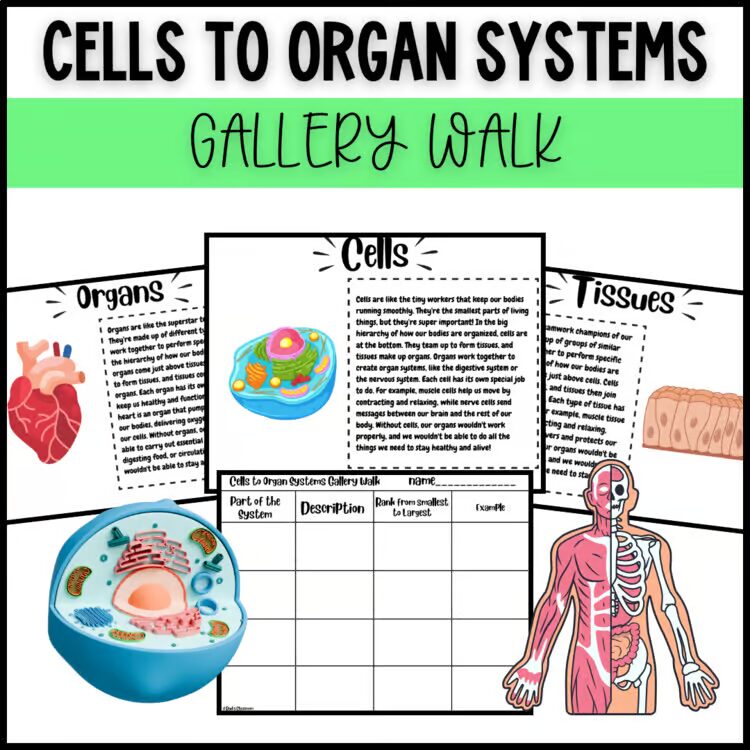
A gallery walk is one of my favorite ways to teach cells to organ systems because it breaks the information into manageable chunks. Instead of listening to a long lecture, students rotate through short reading stations, gather key details, and record examples as they go.
If you want a ready-to-use option, my Cells to Organ Systems Gallery Walk is designed for exactly this. Students read about cells, tissues, organs, and organ systems, then complete a recording sheet that asks them to describe each part of the hierarchy, rank it from smallest to largest, and provide an example. It works well as a no-prep middle school science activity when you want students reading, writing, and moving around the room.
Connect each level to a real job in the body
Once students know the order, give them short scenarios and ask which level is doing the work. For example, if the heart pumps blood, students identify it as an organ. If several organs work together to move oxygen and nutrients, they identify an organ system. These quick checks help students practice the difference between structure and function.
End with a simple explain-it prompt
To wrap up, ask students to explain the hierarchy in their own words: “How does a cell connect to an organ system?” This exit ticket shows whether students truly understand the relationship between cells, tissues, organs, and organ systems. It also gives you a quick read on who needs another example before moving on.
When students can describe the levels of organization with examples, the concept becomes much easier to apply later in life science. A little movement, a few strong visuals, and repeated real-world examples can make this topic feel much less abstract.
For more life science connections, you might also like these biomes teaching strategies or ideas for teaching energy in ecosystems.

