
A Meaningful Mother’s Day Social Studies Activity for Middle School
Mother’s Day can be a little tricky in the classroom. You want something warm and meaningful, but you also want to be sensitive to different family situations and keep the day connected to real learning.
That’s why I love using a social studies twist. Instead of making a traditional card or craft, students can connect Greek mythology, character traits, writing, and personal reflection in a way that feels thoughtful without taking over your whole week.
If you teach Ancient Greece or world history, this kind of activity fits especially well because students are already learning about gods, goddesses, symbols, and traits. Here are a few simple ways to make a Mother’s Day social studies activity feel purposeful, inclusive, and easy to manage.
Start with traits, not just mythology facts
Before students begin, review a few Greek goddesses and the traits they are often associated with. Athena might connect to wisdom and courage. Demeter can connect to care, nurturing, and growth. Hera might connect to leadership or family. Artemis can connect to independence and strength.
The goal is not for students to memorize every myth. The goal is for them to think about how symbols and character traits help people communicate meaning.
A quick class chart works well here. List each goddess, a few traits, and one or two symbols. Then students can choose the goddess that best represents the person they want to honor.
Keep the activity inclusive
Mother’s Day activities can feel uncomfortable for students who do not have a traditional mom figure at home. One small shift makes a big difference: invite students to honor an important adult instead of requiring the activity to be only about a mom.
That could be a mother, grandmother, aunt, guardian, older sibling, family friend, or another role model. This keeps the activity kind and flexible while still letting students participate fully.
You can frame it as: “Choose someone who helps make your house, family, or life feel stronger.” That language gives students room to decide what feels right.
Add writing so it stays connected to learning
A one pager is especially helpful because it gives students space to create, but it also keeps the work structured. Students can compare traits, explain their choice, write a short message, and add illustrations or symbols.
This turns the project into more than a cute seasonal activity. Students are practicing comparison, evidence, reflection, and writing — all while making something personal.
For middle school students, I’d keep the writing expectations short and clear. A few thoughtful sentences are usually better than a long paragraph that starts to feel forced.
Use a ready-to-go Greek mythology one pager
If you want the activity already organized, my Goddess of Our House Greek Mythology One Pager is designed for middle school social studies and works especially well for 6th grade Ancient Greece units.
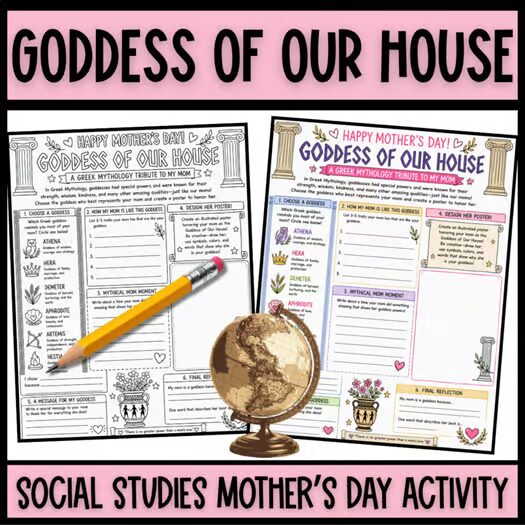
Students choose a goddess that represents an important person in their life, explain the connection, write a personal message, and create a poster-style tribute. It includes color and black-and-white versions, so you can print what works best for your classroom.
You can find the resource here: 6th Grade Social Studies Mother’s Day Activity | Mom Goddess One Pager Printable.
It works well as a low-prep Mother’s Day classroom activity, a sub plan, an Ancient Greece wrap-up, or a creative end-of-unit project.
Wrap it up with a quiet share or gallery walk
Once students finish, you can keep the sharing simple. Let students place their one pagers on their desks and do a quiet gallery walk. They can leave sticky-note compliments, notice symbols, or simply appreciate each other’s work.
If students prefer to keep their projects private, that’s okay too. A meaningful activity does not always need a big presentation. Sometimes the best ending is giving students time to finish carefully and take the project home.
Final thoughts
A Mother’s Day social studies activity can be sweet without becoming disconnected from your curriculum. By using Greek mythology, symbolism, and reflective writing, students get to make something personal while still practicing academic thinking.
And honestly? That balance is the best kind of seasonal classroom activity: thoughtful, low-prep, inclusive, and still worth the class time.
If you are already in an Ancient Greece unit, this also pairs naturally with Ancient Greece achievements or an Athens vs. Sparta comparison lesson.
