
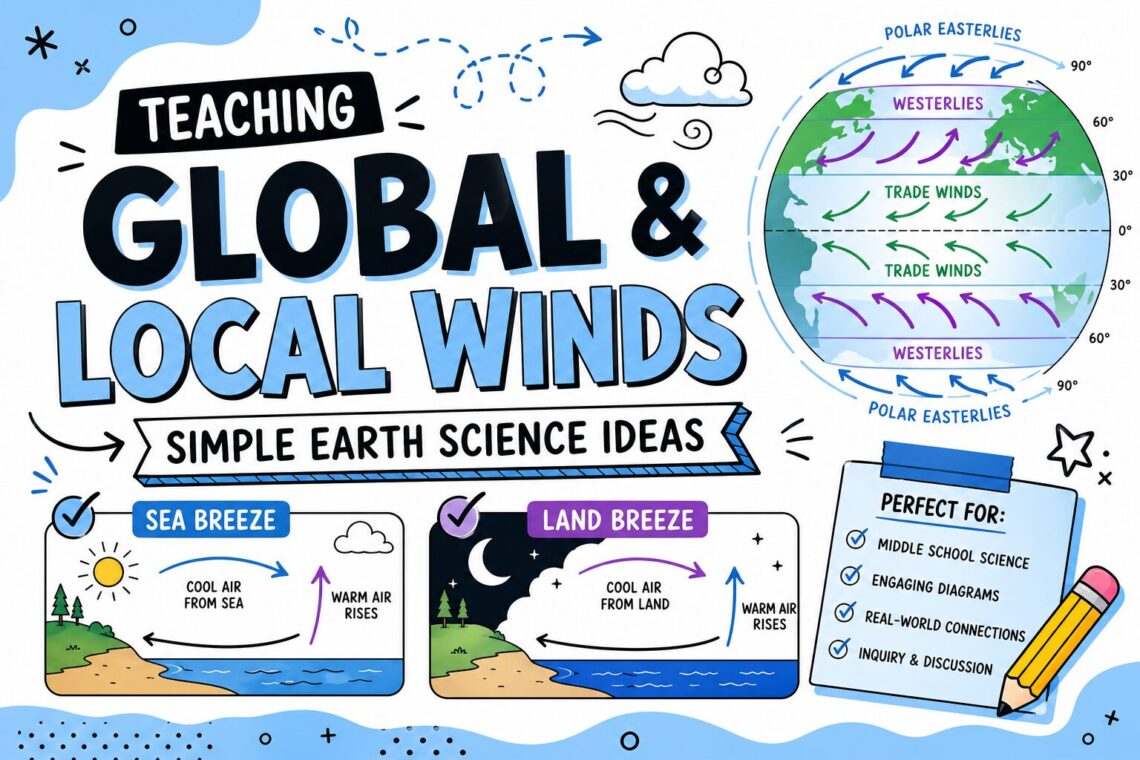
Teaching Global and Local Winds Without Making It Feel Invisible
Global and local winds can be tricky for students because they are learning about something they cannot exactly see happening in front of them. They may memorize terms like trade winds, westerlies, land breeze, and sea breeze, but still struggle to explain where each wind happens or why it matters.
That is why this topic works best when students can compare examples, trace movement, and connect each wind to a real location or pattern. A little structure goes a long way.
Here are a few practical ways to teach global and local winds in middle school science without turning the lesson into one long vocabulary list.
Start with the big idea: air moves because of uneven heating
Before students sort every wind type, make sure they understand the basic pattern: Earth’s surface does not heat evenly, and moving air helps balance those differences.
You do not need to overcomplicate this at first. A simple sketch with warm air rising, cool air sinking, and arrows showing movement can help students see that wind is not random. It is connected to temperature, pressure, and location.
Once students have that foundation, global and local winds feel more like examples of a pattern instead of separate vocabulary words to memorize.
Separate global winds from local winds early
Students often mix up global and local winds because all the terms sound like they belong in the same pile. Give them a clear two-column comparison early in the lesson.
For global winds, focus on large-scale patterns like polar easterlies, westerlies, and trade winds. For local winds, focus on smaller, location-based patterns like sea breeze and land breeze.
This simple comparison helps students organize the unit. They can start asking, “Is this a large global wind belt or a local pattern near land and water?” That one question clears up a lot of confusion.
Use movement with a gallery walk
A gallery walk is a strong fit for teaching global and local winds because students can focus on one wind type at a time. Instead of reading one long passage and trying to keep every detail straight, students rotate through short reading stations and record the key information for each wind.
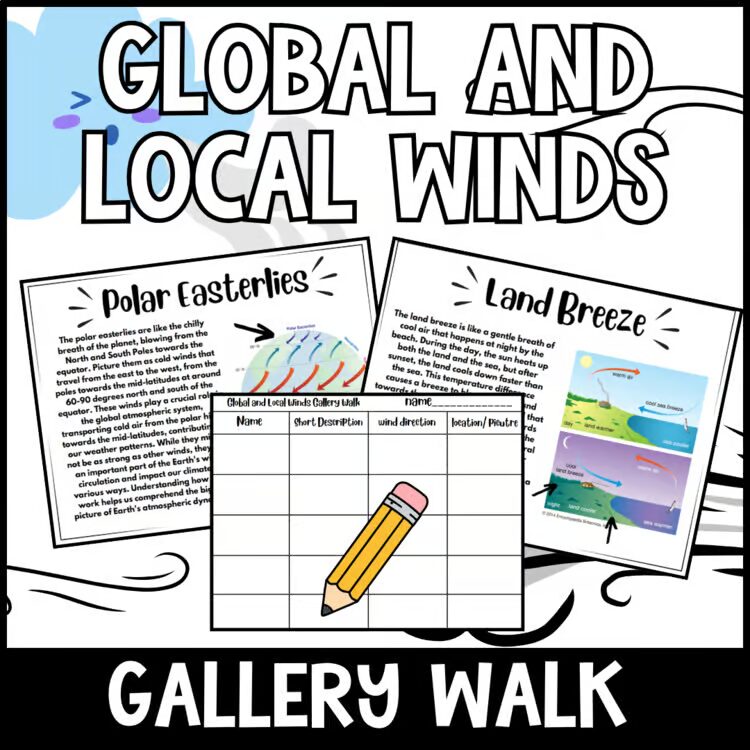
The Global and Local Winds Gallery Walk is built for this kind of lesson. Each station features one global or local wind with a short passage explaining what it is, the direction it blows, and where it happens. Students fill out an answer sheet as they rotate, which keeps them reading with a purpose instead of just skimming.
It works well as an introduction to winds, a station rotation during your weather unit, or a low-prep way to add reading into science without losing student engagement.
Have students compare direction and location
Once students have read about each wind, ask them to compare two details: direction and location.
- Which winds are part of global wind belts?
- Which winds happen near land and water?
- Which winds blow from east to west?
- Which winds are connected to daily heating and cooling?
This pushes students beyond matching terms to definitions. They begin using evidence from the readings to explain how the winds are alike and different.
End with a quick explanation task
A short written explanation can show you whether students actually understand the difference between wind types. Keep it focused and doable.
- Explain the difference between a land breeze and a sea breeze.
- Choose one global wind and describe its direction and location.
- Why are global and local winds important in an Earth science unit?
These quick responses are especially helpful because students have to turn vocabulary into clear science language. That is usually where the real understanding shows up.
Make global and local winds easier to visualize
Global and local winds do not have to feel abstract forever. When students can see patterns, compare examples, move through stations, and explain each wind in their own words, the topic becomes much more manageable.
If you want a low-prep way to make the lesson more student-led, the Global and Local Winds Gallery Walk gives students short readings, an organized recording sheet, and a clear structure for learning polar easterlies, westerlies, trade winds, sea breeze, and land breeze.
You can find the activity here: Global and Local Winds Gallery Walk

