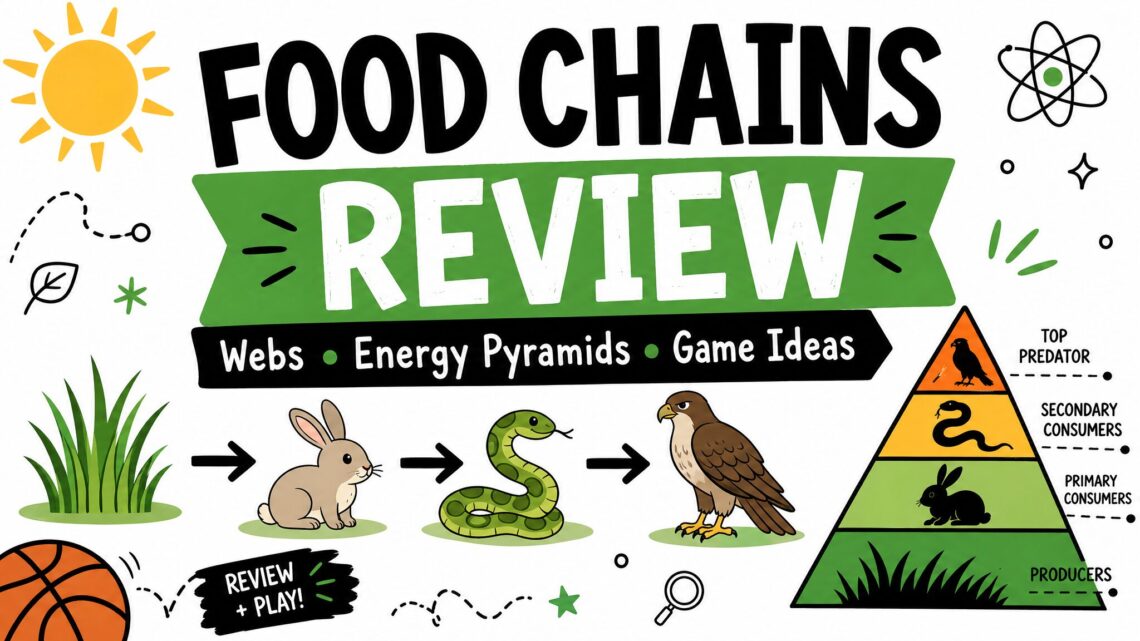
Food Chains Review Game Ideas for Upper Elementary Science
Food chains, food webs, and energy pyramids are usually not the hardest ecosystem topics to introduce. Students can follow the arrows, name a producer, and explain that energy starts with the sun. Then review day shows up, and suddenly all of those little details start running together.
That is when I like using a food chains review game instead of only handing out another practice page. Students still need to retrieve the content, read the question carefully, and explain their thinking. They just do it with a little more energy. And honestly, that helps a lot when you are trying to review ecosystems with upper elementary or middle school students who are already thinking about lunch, dismissal, or the next big thing.
Start with the vocabulary students keep mixing up
Before jumping into a game, I like to quickly pull out the terms that cause the most confusion. For this topic, it is usually:
- producer, consumer, predator, and prey
- herbivore, carnivore, and omnivore
- food chain vs. food web
- energy pyramid levels
- what the arrows actually mean
A two-minute warm-up works fine here. Put up a simple chain like grass → rabbit → snake → hawk and ask students to label each part. Then ask one extra question: “Where is the energy moving?” That question is small, but it catches a lot of misconceptions before the review game begins.
Use quick questions to keep review moving
For ecosystems review, I prefer short multiple-choice questions mixed with quick discussion. Long open-ended questions have their place, but a review day can drag if every single question turns into a full paragraph response.
Short questions let students practice more examples. They can identify the producer, choose what happens if one organism is removed, compare two pyramid levels, or decide which food web statement is supported by the diagram. Those repeated little retrieval moments matter.
My favorite rhythm is simple: question, answer, quick explanation, move on. If students miss it, we pause just long enough to fix the thinking. Then we keep going.
Add movement without losing control of the room
I am all for a fun science review game, but I still want it to feel manageable. The sweet spot is a game that gets students engaged without turning the classroom into chaos.
Trashketball works well for this because the science part still comes first. Students answer the food chains, food webs, or energy pyramids question before anyone gets to shoot. The basketball part is just the motivation layer. It gives students a reason to cheer, but the actual work is still retrieval practice.
A few small rules help:
- Teams must agree on an answer before shooting.
- Students have to explain the answer if called on.
- Only one student shoots at a time.
- The class stays quiet enough to hear the question and explanation.
Nothing fancy. Just enough structure to keep it from becoming “who can throw paper the loudest.”
Review food webs with cause-and-effect questions
Food webs are where students can really start thinking, not just labeling. Once they understand the organisms in the diagram, ask what would happen if a population increased, decreased, or disappeared.
These questions make students look back at the arrows and actually use the diagram. They also connect nicely to real ecosystem thinking. If the rabbit population decreases, what might happen to the grass? What might happen to the predator that eats the rabbit? Students have to reason through the relationships instead of just memorizing definitions.
That is one reason I like including food webs in an ecosystems review activity. They give students a chance to practice reading diagrams, making predictions, and explaining cause and effect all at the same time.
Bring energy pyramids into the same review
Energy pyramids can feel separate from food chains and food webs, but they really belong in the same conversation. Students need to see that energy is not just moving from one organism to another. Less energy is available as you move up the pyramid.
During review, I like asking questions like:
- Which level has the most available energy?
- Why are there fewer top predators than producers?
- Where would this organism belong in the pyramid?
- What happens to available energy as it moves up?
These are the kinds of questions that help students connect the diagram to the bigger ecosystem idea. They are also perfect for a quick review game because students can answer, explain, and move to the next example without a huge setup.
Try a ready-to-use food chains Trashketball review game
If you want the review already built, I created this Food Chains, Webs, & Energy Pyramids Trashketball Review Game for upper elementary and middle school science.
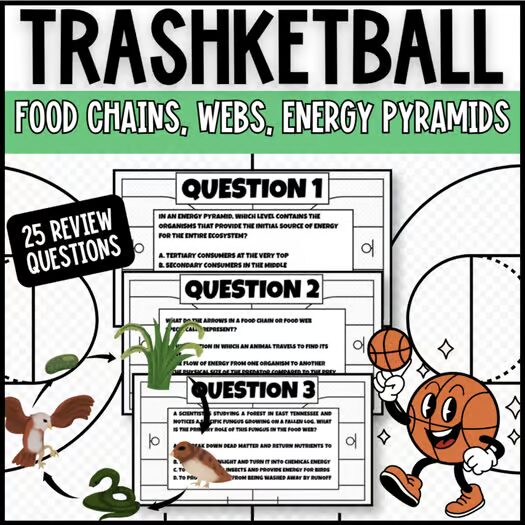
It includes 25 multiple-choice review questions with answer slides, so students can practice food chains, food webs, energy pyramids, and ecosystem vocabulary in a game format. I’m biased because I made this one, but I like it for test prep, end-of-unit review, or those days when you need students retrieving science content without another quiet worksheet.
The slideshow is presentable and editable in Canva, which is helpful if you want to adjust a question, slow the pacing down, or make it match exactly what your class has covered.
End with one written reflection
After the game, I still like ending with a tiny written piece. It does not need to be long. One good exit ticket can help students settle and show what actually stuck.
Try one of these:
- Explain what the arrows in a food chain show.
- Describe one thing that could happen if a predator is removed from a food web.
- Why does an energy pyramid get smaller at the top?
- Write one question you still have about ecosystems.
That last minute of writing gives you useful information, and it helps students move from the excitement of the review game back into actual science thinking.
Food chains and energy pyramids do not have to be a dull review day. With the right mix of quick questions, movement, diagrams, and retrieval practice, students can review the ecosystem content in a way that feels a lot more classroom-real. And hopefully, a little more fun for you too.
Grab free no-prep science & social studies resources
Get instant access to review templates, vocabulary posters, gallery walk samples, quick-check activities, and hands-on practice ideas for upper elementary and middle school.