American Revolution Battles Gallery Walk Ideas for Your U.S. History Unit
American Revolution battles can start to blur together for students pretty quickly. Lexington and Concord, Bunker Hill, Saratoga, Trenton, Yorktown… they may recognize the names, but remembering why each battle mattered is a different story.
That is why I like turning this part of the unit into an American Revolution battles gallery walk. Students get up, move around the room, read short pieces of information, and record the details they actually need. It feels more manageable than one long lecture, and it gives them a little variety while they work through the Revolutionary War content.
Start with the battles students truly need to know
You do not have to cover every single battle in the war for students to build a solid understanding. I would rather go deeper with the battles that show the bigger story of the Revolution.
For a grades 4-8 U.S. History lesson, these are the ones I usually want students to slow down with:
- Lexington and Concord
- Battle of Bunker Hill
- Battle of New York
- Battle of Trenton
- Battle of Saratoga
- Battle of Yorktown
That set gives students a clear beginning, middle, and end. They can see the war start, notice early struggles, understand turning points, and then connect Yorktown to the end of the fighting.
Give each station one clear job
Gallery walks work best when the stations are not trying to do too much. If each stop has a short reading passage and a few focused things to find, students are more likely to actually read instead of skimming for random words.
For American Revolution battles, I like having students look for the same basic information at each station:
- Where did the battle happen?
- Who won?
- Why was it important?
- What detail helps explain the bigger Revolutionary War story?
That repetition is helpful. Students are not learning a brand-new task at every station. They can focus their brain power on the history instead.
Use movement, but keep it calm
I am very pro-movement, but I still want the room to feel like we are learning and not just wandering. A gallery walk gives students a reason to stand up and rotate, but the structure matters.
A few simple routines help a lot:
- Put students in pairs or small groups.
- Give each group a starting station.
- Use a timer so rotations do not drag.
- Require the answer sheet to travel with them.
- Pause halfway through if you need to reset expectations.
Nothing fancy. Just enough structure so students are moving, reading, and writing instead of treating it like a hallway field trip inside your classroom.
Ask students to compare battles after the gallery walk
The best part comes after students have visited the stations. Once they have the basic information down, you can ask better questions.
Try a quick class discussion or written response like:
- Which battle do you think was the biggest turning point? Why?
- How did the Patriots’ situation change from the beginning of the war to the end?
- Which battle surprised you the most?
- What pattern do you notice across the major Revolutionary War battles?
This is where students move beyond copying facts. They start using the details to make a claim, explain significance, and connect one event to another.
Try a ready-to-use American Revolution battles gallery walk
If you want the station work already built, I created this American Revolution Battles Gallery Walk for upper elementary and middle school social studies.
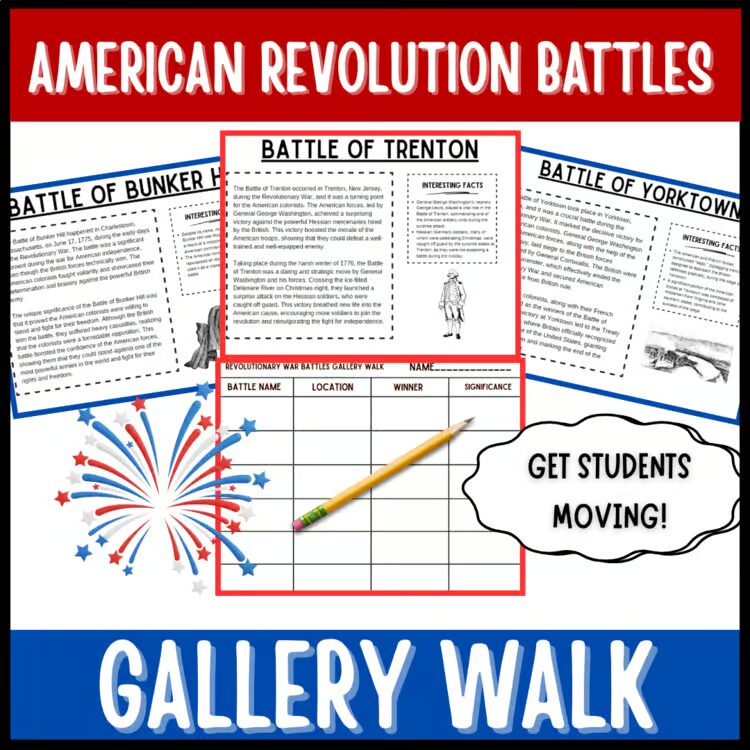
It includes dedicated pages for major Revolutionary War battles, short reading passages, and a student answer sheet. I’m biased because I made this one, but I like it for the exact reason gallery walks usually work so well: students are not just sitting and listening. They are reading, moving, looking for key information, and writing as they go.
It pairs especially well with a larger American Revolution unit when you want students to understand the major battles without spending multiple days on lecture notes.
End with one quick retrieval piece
After the gallery walk, I like ending with a small retrieval task. It helps students pull the information back out before it disappears into the land of “I definitely knew this five minutes ago.”
You could ask students to write one sentence for each battle, rank the battles by importance, or choose the battle they think changed the war the most. Even a quick exit ticket works.
The goal is not to make the lesson complicated. A strong American Revolution battles activity just needs students reading useful information, moving with purpose, and doing a little thinking with the facts. That is the sweet spot.
Grab free no-prep science & social studies resources
Get instant access to review templates, vocabulary posters, gallery walk samples, quick-check activities, and hands-on practice ideas for upper elementary and middle school.