
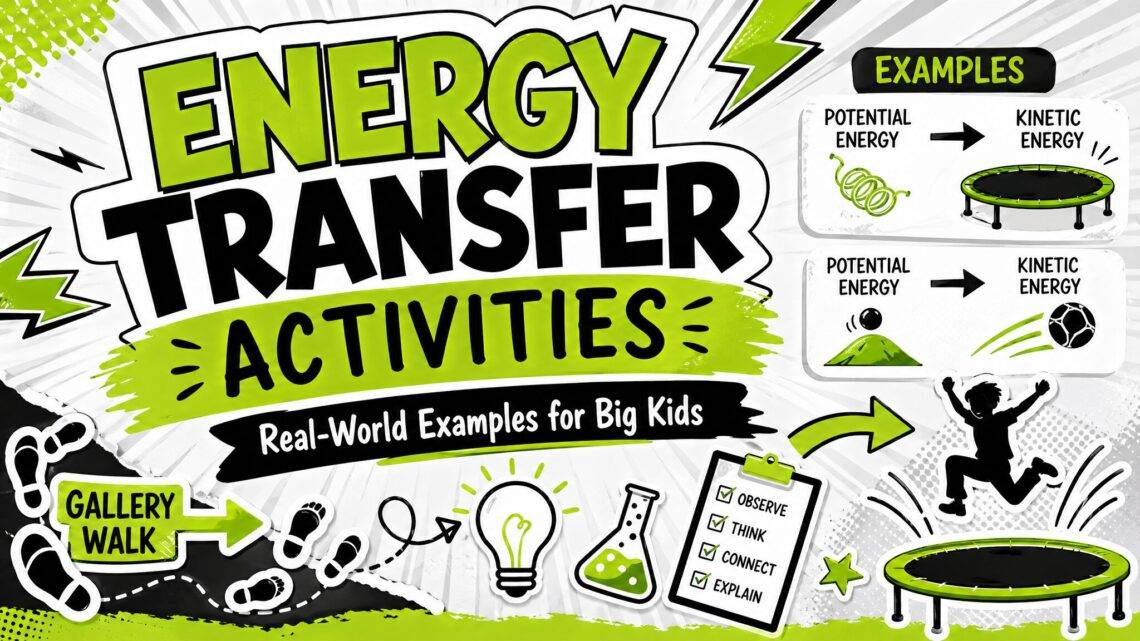
Energy Transfer Gallery Walk Activities for Real-World Science Practice
Energy transfer is one of those topics that can sound simple when we say it out loud, but students still need a lot of practice seeing it in real life.
They may know the words potential energy and kinetic energy, but then they freeze when a scenario asks them to explain what is actually happening. A ball is dropped. A trampoline stretches. A hot air balloon rises. Energy is moving, changing, and showing up in different forms — and students need practice noticing it.
My favorite solution is to get them out of their seats and give them real-world examples to talk through. An energy transfer gallery walk works really well for this because students are reading, moving, writing, and diagramming instead of just staring at another set of notes.
Start with everyday energy transfer examples
Before students diagram anything, I like to anchor the lesson in examples they can picture. Trampolines, roller coasters, batteries, food, light bulbs, and hot air balloons are all easier to understand than a generic definition on the board.
You can ask quick questions like:
- Where is the energy stored at the beginning?
- When does it start moving?
- What forms of energy can we see, hear, or feel?
- Where does some of the energy go at the end?
This keeps potential and kinetic energy from feeling like vocabulary students memorize for a quiz and then immediately forget.
Use movement so students actually slow down and read
I’m biased toward gallery walks because they solve a very real classroom problem: students need repeated practice, but they also get tired of sitting in one spot.
With an energy transfer gallery walk, each station gives students a short scenario. They read the passage, identify the types of energy involved, and then explain the energy transformation. The movement helps, but the real win is that each station gives them a fresh example without making the activity feel like a long worksheet.
It also gives you a second to breathe while still having students do the thinking. And honestly, that matters.
Have students diagram the full energy transformation
One thing that helps big kids is making them show the whole path of the energy. Instead of only writing “potential to kinetic,” have them add the extra forms they notice: sound, thermal, light, electrical, chemical, elastic potential, gravitational potential, and so on.
A simple arrow diagram works great:
stored energy → motion → sound/thermal/light energy
The diagram doesn’t need to be fancy. The point is retrieval. Students have to crawl back into their memory, choose the right energy types, and connect them to the scenario in front of them.
Try a ready-to-use energy transfer gallery walk
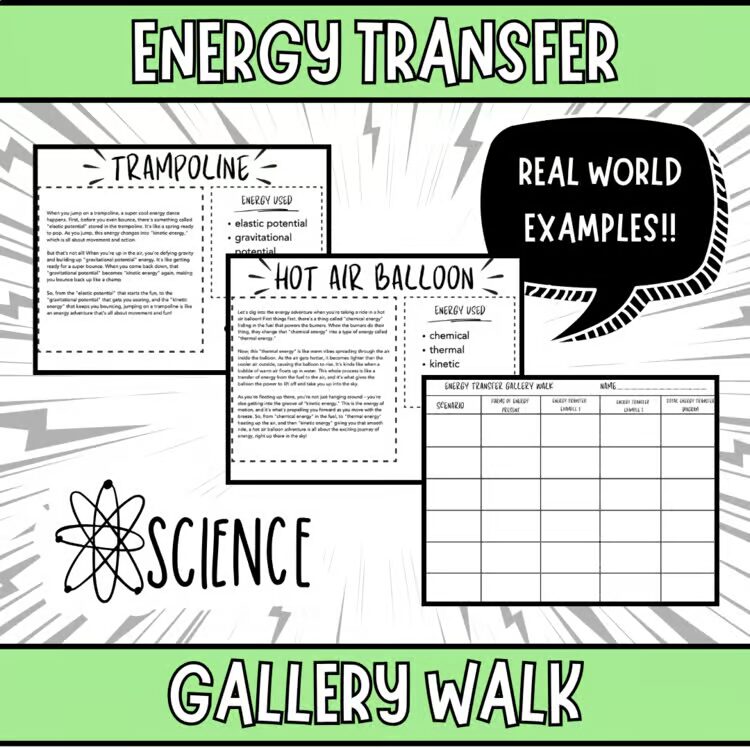
If you want this already set up, I made an Energy Transfer Gallery Walk with real-world science stations for potential energy, kinetic energy, and other common energy transformations.
Students rotate through the stations, read each short passage, record the energy transfers they find, and diagram the full transformation. It is made for grades 4–8, and it gives students a nice mix of reading, movement, writing, and science thinking.
End with one quick reflection question
After the activity, I like ending with one simple exit question: Which station had the most interesting energy transformation, and why?
It is quick, but it forces students to revisit an example and explain their thinking in their own words. That is where you can usually tell who is just naming energy types and who is actually understanding the transfer.
Energy transfer activities do not have to be complicated. Give students real examples, let them move a little, and make them explain the path of the energy. That combination usually gets the idea to stick a lot better than notes alone.
Grab free no-prep science & social studies resources
Get instant access to review templates, vocabulary posters, gallery walk samples, quick-check activities, and hands-on practice ideas for upper elementary and middle school.