Going for Gold: 3 Winning Strategies to Bring the Winter Olympics into Your Classroom
The Winter Olympics are one of those rare events students actually hear about outside of school. Suddenly everyone has an opinion about figure skating, snowboarding, curling, or some sport they had never watched before.
That excitement is useful. The Olympics can connect to geography, history, reading, math, perseverance, culture, and current events. The trick is using the energy without creating a giant project you do not have time to manage.
Here are three Winter Olympics classroom activities that bring the games into your room without making your planning life harder.
1. Design a new Winter Olympic event
This is a fun one because students get to be creative, but they still have to think logically. Challenge them to invent a brand-new winter sport that belongs in the Olympics.
They need to plan the basics:
- the name of the event
- the rules and scoring system
- the equipment athletes would need
- the type of snow or ice venue required
- why the event deserves to be included
Then students present their sport to the “International Olympic Committee,” which is just the class with a much more official-sounding name. It is usually funny, but it also gets students thinking about fairness, competition, safety, and design.
2. Add Olympic math medals
Olympic data makes math feel a little less random. Instead of generic word problems, use times, distances, scores, medal counts, and travel schedules.
Students can calculate the time difference between your city and Milano, compare bobsled run times, average figure skating scores, graph medal totals, or convert metric distances from ski jumping and speed skating.
It is still math practice, but the context gives it a reason. I like when students can see that numbers are not just living on a worksheet. They are part of real events happening in the world.
3. Use a History of the Winter Olympics gallery walk
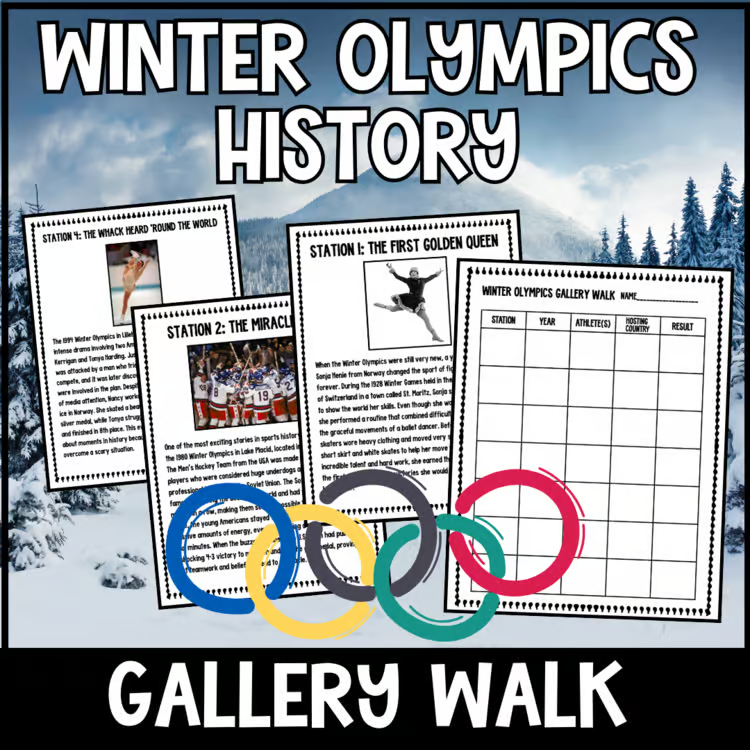
This is my favorite way to bring in reading and history. I created this History of the Winter Olympics Gallery Walk so students could learn about memorable Olympic moments while still practicing reading for details.
Students rotate through 7 stations featuring stories from Winter Olympic history, including moments like the “Miracle on Ice,” Eddie the Eagle, Shaun White, Chloe Kim, and more. The passages are written so students have to actually read, not just skim for a bold word.
I like it because it gets them moving and gives them high-interest nonfiction practice. I can print the posters, tape them around the room, hand out the recording sheet, and then spend my time checking in with students instead of performing a lecture.
You can grab the History of the Winter Olympics Gallery Walk here.
Let the games begin
The Winter Olympics are a perfect excuse to add a little variety to your classroom. Design something. Read something. Graph something. Talk about countries, athletes, and moments students may actually see on TV or online.
Hopefully these Winter Olympics classroom activities help you use the excitement of the games without having to reinvent your whole week. That is always the sweet spot.
Ready-to-use classroom resource
Want this classroom resource ready to print?
Save planning time with a classroom-ready activity built for upper elementary and middle school teachers.
For more seasonal classroom ideas, you might also like these Valentine’s Day activities or Principal Appreciation ideas.

