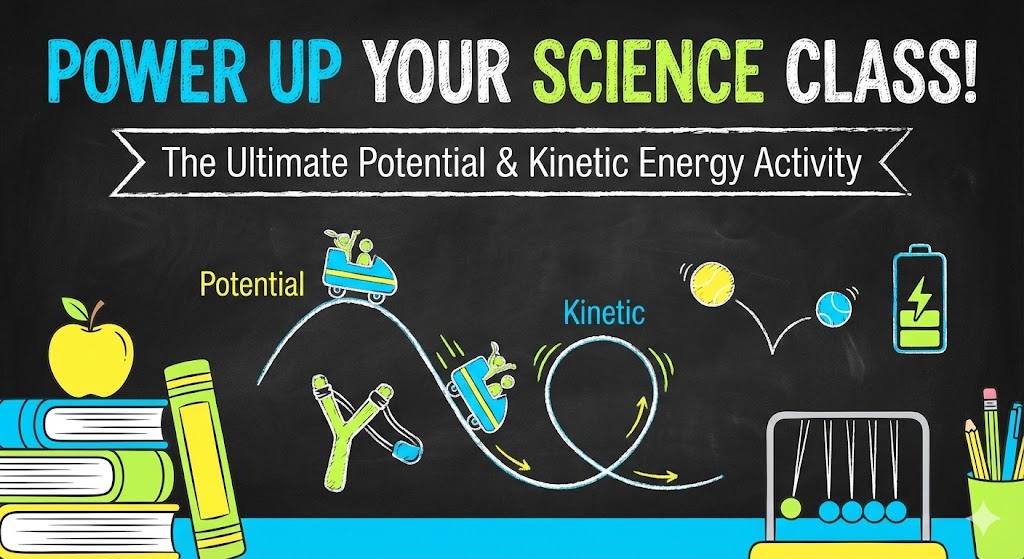
The Ultimate Potential and Kinetic Energy Activity to Get Students Moving
Potential and kinetic energy can be tricky because students cannot exactly hold “stored energy” in their hands. They can say the definitions back to us, but then a roller coaster, a rubber band, a flashlight, and a falling book all start to blur together.
That is why I like teaching energy with activities where students can see it, feel it, and explain it in their own words. A good potential and kinetic energy activity should get students doing more than copying vocabulary. They need examples, movement, and chances to describe what is changing.
Here are three ways I like to make energy transfer more visible in science class.
1. Use an energy transfer gallery walk
This is my favorite place to start because it combines reading with movement. Students are not just sitting with a worksheet trying to remember which energy is which. They are moving from station to station and applying the vocabulary to real situations.

I created this Energy Transfer Gallery Walk for exactly that reason. Each station gives students a scenario to read and analyze. They identify the types of energy involved and think through how energy changes form.
Students work with examples of gravitational potential energy, elastic potential energy, kinetic energy, thermal energy, chemical energy, sound, light, and electrical energy. It is a lot of vocabulary, but the gallery walk format helps it feel manageable.
I like that students leave with a recording sheet they can actually use to study. Plus, it gives me time to circulate, ask questions, and catch misconceptions while they are working instead of after the quiz.
You can grab the Energy Transfer Gallery Walk here.
2. Build rubber band racers
Rubber band racers are great because students can feel the potential energy building. When they wind the rubber band tighter, there is tension. When they let it go, the car moves. That is a nice, concrete moment for a concept that can otherwise feel invisible.
You can keep the materials simple: cardboard tubes, rubber bands, skewers, bottle caps or CDs for wheels, and tape. The challenge is to build a racer that travels the farthest distance.
After the race, have students write a quick explanation using the words potential energy, kinetic energy, and energy transfer. The writing piece is important. The activity is fun, but the explanation is where you find out who really gets it.
3. Try a pendulum bowling experiment
This one is simple, but it works. Tie a washer or small ball to a string and set up a “bowling pin” at the bottom of the swing path. A marker, empty water bottle, or plastic cup works fine.
Then have students release the pendulum from different heights and observe what happens.
- A low release point may barely move the pin.
- A higher release point usually creates a much stronger hit.
- Students can connect height to gravitational potential energy and motion to kinetic energy.
It is a quick visual that gives them something to point back to later. “Remember when we raised the pendulum higher?” is much better than “remember the definition from your notes?”
Keep the energy visible
When students can watch potential energy turn into kinetic energy, the vocabulary starts to make more sense. Build the racer. Swing the pendulum. Walk through examples. Then make them explain what happened.
That mix of reading, movement, building, and writing is what usually makes a potential and kinetic energy activity stick.
Ready-to-use classroom resource
Want this science resource ready to print?
Save planning time with a classroom-ready activity built for upper elementary and middle school teachers.
For more physical and Earth science connections, you might also use energy in ecosystems or these weathering and erosion ideas.
Classroom-ready resource
Want the ready-to-use version?
If you want the activity without building it from scratch, this resource is ready to print, share, and use with upper elementary or middle school students.
Grab free no-prep science & social studies resources
Get instant access to review templates, vocabulary posters, gallery walk samples, quick-check activities, and hands-on practice ideas for upper elementary and middle school.