Teaching Principles of the Constitution Without Another Definitions List
Principles of the Constitution can turn into a vocabulary list really fast. Checks and balances. Federalism. Limited government. Popular sovereignty. Students may copy the definitions, but that does not always mean they can explain why those ideas matter or what they actually look like in our government.
That is why I like using a Principles of the Constitution gallery walk during a U.S. Constitution unit. It slows the content down, gives students a reason to move, and lets them work with one principle at a time instead of staring at a big wall of abstract terms.
Start with the problem: the words are abstract
Some social studies topics are hard because students have no mental picture for them yet. “Separation of powers” sounds official, but students need examples before it really clicks. Same with federalism or limited government.
Before I ask students to memorize anything, I want them reading short explanations, looking for examples, and putting the idea into their own words. That little shift makes a U.S. Constitution activity feel less like copying notes and more like figuring out how the system works.
Give each principle its own stop
For a gallery walk, I like setting up one station for each big constitutional principle. Students rotate around the room and focus on one idea at a time:
- Checks and balances
- Federalism
- Republicanism
- Separation of powers
- Limited government
- Popular sovereignty
- Individual rights
This works especially well for upper elementary and middle school because the movement helps, but the task still stays academic. Students are reading, writing, and organizing the information as they go. Not just wandering around the room with a clipboard. 🙂
Ask for more than the definition
My favorite way to make Constitution reading stations more useful is to ask students for a few different pieces of information at every stop. A simple answer sheet can have students record:
- the name of the principle
- a student-friendly description
- why the principle was included in the Constitution
- an example of the principle in action
That structure matters. If students only write the definition, they can finish the page without really thinking. But when they have to explain why checks and balances exist or give an example of limited government, they have to crawl back into the reading a little bit. That retrieval piece is so helpful.
Use examples to make the principles stick
Examples are where the light bulbs usually happen. A checks and balances activity is stronger when students can connect the phrase to something concrete, like a presidential veto, Congress overriding a veto, or the Supreme Court reviewing laws.
The same is true for the other principles. Federalism makes more sense when students think about national and state powers. Individual rights feel more real when they connect the idea to freedoms protected in the Bill of Rights. The principle is the vocabulary word, but the example is usually what students remember.
Try the ready-to-use gallery walk
If you want the stations already built, I created this Principles of the Constitution Gallery Walk for grades 4-8 social studies.
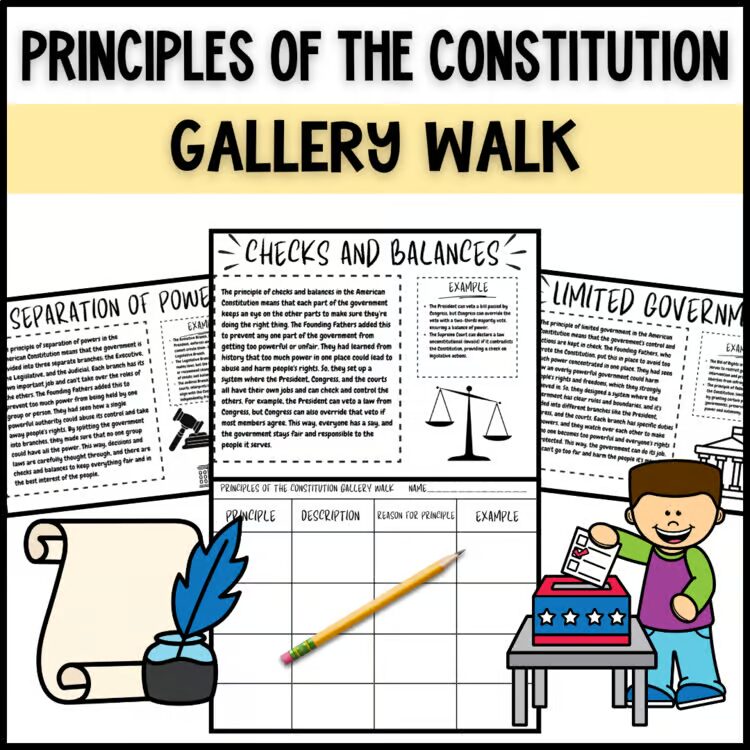
I’m biased because I made it, but this is exactly the kind of Constitution lesson I like: students get up, read short passages, write purposeful responses, and work through the major principles without needing a long lecture from me the whole time. It covers checks and balances, federalism, republicanism, separation of powers, limited government, popular sovereignty, and individual rights.
It also gives you a nice “breather” lesson that still feels observation-friendly because students are reading, moving, writing, and using examples from the text.
Wrap it up with one quick synthesis question
After the gallery walk, I like ending with one short question that forces students to compare the principles. You could ask:
- Which principle do you think is most important for preventing one person or group from getting too much power?
- Which two principles work together the most?
- Which principle is easiest to see in real life today?
Those questions are simple, but they push students beyond matching terms and definitions. They have to use what they read.
If your Constitution unit needs a little more movement and a little less “copy this definition,” a Principles of the Constitution gallery walk is a practical way to help students make sense of the big ideas one station at a time.
Grab free no-prep science & social studies resources
Get instant access to review templates, vocabulary posters, gallery walk samples, quick-check activities, and hands-on practice ideas for upper elementary and middle school.