Teaching Early American Explorers Without Another Long Lecture
Early American explorers can be a tricky topic because there are a lot of names, dates, routes, and “why does this matter?” details all packed together. Students might remember Columbus, but then Magellan, Vespucci, De Soto, Hudson, Ponce de León, Cortés, and Pizarro can start to blur into one giant explorer soup.
That is exactly why I like turning this unit into an Early American Explorers gallery walk. It gives students a way to slow down, read in smaller chunks, and physically move from explorer to explorer instead of trying to absorb everything from one long lecture.
Start with the same simple question at every stop
When students rotate through an explorers activity, I do not want them copying random facts just to fill a page. I want them looking for the same important details each time:
- Who was the explorer?
- When did the exploration happen?
- Where did they go?
- What was the goal of the journey?
- Why was it historically significant?
That repeated structure helps a lot. Students know what they are looking for, so the reading feels more manageable. It also makes it easier to compare explorers later because everyone has gathered the same types of information.
Use movement, but keep the purpose clear
I am biased toward gallery walks because they get students up without turning the room into total chaos. The movement has a job. Students rotate, read, write, and move on.
For an early American explorers reading stations lesson, I like posting one explorer at each station. Students can work independently, with a partner, or in small groups depending on the class. The key is that they have to read closely enough to pull out the route, goal, and significance instead of just skimming for a name.
Build in a quick compare-and-discuss moment
The best part of an explorers gallery walk is what happens after students have the information in front of them. Once they have visited the stations, you can ask quick comparison questions like:
- Which explorer had the biggest impact? Why?
- Which explorers were looking for similar things?
- Whose journey had the most surprising result?
- How did exploration affect the people and places involved?
Those questions push students past “I found the answer” and into actual social studies thinking. They have to use the details they collected, not just repeat them.
Try a ready-to-use Early American Explorers gallery walk
If you want the stations already built, I created this Early American Explorers Gallery Walk Reading Stations Activity for grades 4-8 social studies.
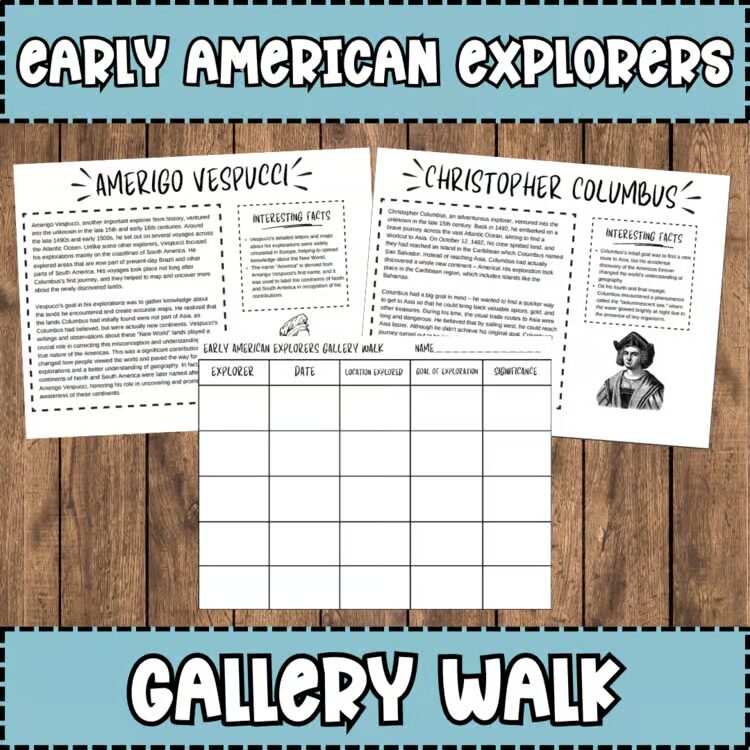
Students rotate through stations for explorers like Christopher Columbus, Ferdinand Magellan, Amerigo Vespucci, Robert de La Salle, Hernando de Soto, Henry Hudson, Juan Ponce de León, Hernán Cortés, and Francisco Pizarro. Each station gives them a short passage and asks them to record the key information, so they are reading, moving, writing, and organizing the content as they go.
It works well when you want an Age of Exploration activity that feels active but still has students doing real reading and thinking.
End with one synthesis task
After the gallery walk, I like ending with one simple task that pulls everything together. Students can rank the explorers by impact, choose the explorer they think changed history the most, or write a short response comparing two journeys.
It does not have to be fancy. The goal is to make students crawl back into the information one more time and use it. That little retrieval moment is so helpful, especially with a content-heavy topic like European exploration.
If your students need a change of pace during your early America unit, an Early American Explorers Gallery Walk is a practical way to get them reading, moving, and making sense of the explorers one station at a time.
Grab free no-prep science & social studies resources
Get instant access to review templates, vocabulary posters, gallery walk samples, quick-check activities, and hands-on practice ideas for upper elementary and middle school.