How to Plan an American Revolution Unit with Low-Prep Activities
Planning an American Revolution unit can feel like a lot because students are trying to understand events, people, battles, protests, vocabulary, and big ideas all at once. If the unit turns into one long lecture or packet, the details can start blending together fast.
When I teach this topic, I want students to see the Revolutionary War as more than a timeline to memorize. They need chances to read, move, summarize, compare, and talk through the choices people made during the Revolution.
That is why I like building an American Revolution unit with a mix of low-prep activities. A few strong routines can help students understand the major events while still keeping the unit manageable for you.
Start with the big picture
Before students dive into every battle or historical figure, it helps to give them a clear question to carry through the unit:
Why did the colonies fight for independence, and how did different people shape the outcome?
That question gives students a purpose for reading. They are not just collecting names and dates. They are looking for causes, decisions, risks, and consequences.
You can come back to that question after each activity. After reading about an important person, students can explain how that person influenced the Revolution. After learning about a battle, they can explain why it mattered. After reviewing key events, they can connect those events back to independence.
Use gallery walks for people and battles
Gallery walks work really well for American Revolution lessons because they break the content into smaller pieces. Instead of giving students one long reading passage, you can set up short stations around the room.
Each station can focus on one topic, such as:
- an important Revolutionary War battle
- a key leader or historical figure
- women of the American Revolution
- a cause or turning point in the road to independence
At each stop, students read, record the most important details, and move to the next station. That movement helps upper elementary students stay engaged, but the structure still keeps the lesson focused.
I especially like using the same thinking pattern at each station. Students might record who or what the station is about, why it mattered, and one detail that helped them understand the bigger unit. Repeating that structure makes the reading feel more manageable.
Mix in task cards for close reading
Task cards are another simple way to build reading practice into your American Revolution unit. They are easy to use in small groups, partner work, centers, or as a review activity before a quiz.
The key is to make sure students are doing more than hunting for one-word answers. Good close reading questions should push students to go back to the text, use evidence, and explain their thinking.
For example, students might read about colonial resistance, a Revolutionary War figure, or a major event and then answer questions about main idea, vocabulary, cause and effect, or point of view. Those reading skills matter just as much as the history content.
Give students a reason to compare
One of the best ways to help students understand the American Revolution is to ask them to compare what they learn. Instead of treating each lesson as separate, build in quick comparison questions throughout the unit.
Try prompts like:
- Which battle had the biggest impact on the war?
- Which person took the biggest risk?
- How did women contribute to the Revolution in different ways?
- Which event made independence feel more likely?
These questions work well after a gallery walk because students have several examples fresh in their minds. There is not always one perfect answer, which is what makes the discussion useful. Students have to use evidence from the activity to defend their thinking.
Keep review active and low-prep
By the end of the unit, students usually need a way to revisit the people, events, battles, and vocabulary they have learned. Review does not have to be complicated. A simple color by number, task card set, or partner review activity can give students one more pass through the content without adding a lot of prep.
I like review activities that make students slow down just enough to retrieve information. If they have to match a person to a contribution, connect a battle to its importance, or answer a short reading question, they are practicing the content in a more meaningful way than just rereading notes.
A low-prep American Revolution bundle option
If you want several of these activities already built for you, I created an American Revolutionary War Activity Bundle for 4th and 5th grade social studies.
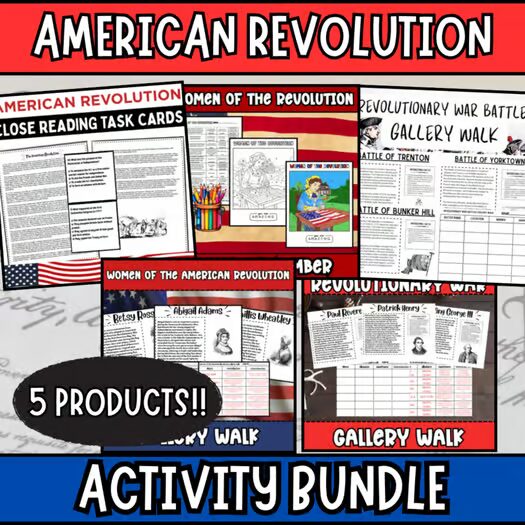
The bundle includes five resources you can use across your unit:
- American Revolution close reading comprehension task cards
- American Revolutionary War battles gallery walk
- Important people of the American Revolutionary War gallery walk
- Women of the American Revolution gallery walk
- Women of the American Revolutionary War color by number activity
You can use the activities together for a fuller unit, or pull individual pieces when you need a station activity, reading practice, or review day. The goal is to make the unit easier to plan while still giving students different ways to interact with the content.
Connect the unit to causes and consequences
If students are still building background knowledge, it can help to start with the events that pushed the colonies toward independence. I have a separate post on using a Causes of the American Revolution gallery walk, which pairs naturally with this unit because it helps students understand the road to war before they focus on battles and people.
However you structure the unit, the main goal is the same: help students connect the people, battles, and choices of the American Revolution into one bigger story. Low-prep activities can make that much easier because students are reading, moving, discussing, and reviewing without every lesson needing to be built from scratch.
Grab free no-prep science & social studies resources
Get instant access to review templates, vocabulary posters, gallery walk samples, quick-check activities, and hands-on practice ideas for upper elementary and middle school.

Trey
Trey creates low-prep science, social studies, and ELA resources for upper elementary and middle school teachers through A Dad’s Classroom.