Making Weather Visible: 3 Engaging Activities for Air Masses and Weather Fronts

Teaching weather is one of those units that can either be incredibly exciting or… surprisingly abstract. We talk about “invisible battles” in the sky between warm and cold air, but unless we make it concrete, our students just see blue triangles and red semicircles on a map and move on. The challenge is getting them to visualize what is actually happening when a cold air mass bulldozes into a warm one. How do we help them predict the weather instead of just memorizing definitions? If you are looking for ways to bring your meteorology unit to life, here are three of my favorite strategies to help students master air masses and weather fronts! 1. The “Density Tank” Demo This is a classic for a reason—it is the single best way to show why fronts happen. You can’t teach weather without teaching density! The Setup: The “Aha!” Moment: When you lift the barrier, students will instantly see the cold, dense blue water slide underneath the warm, less dense red water. It’s a perfect visual for a Cold Front. You can discuss how this rapid lifting of warm air causes the thunderstorms we associate with cold fronts. It clicks instantly! 2. “Weather Front” Body Movement Middle schoolers might roll their eyes at “acting it out,” but secretly, they love the chance to move (and it helps the kinetic learners!). Divide the class into “Warm Air” molecules (who stand far apart and move quickly) and “Cold Air” molecules (who stand close together and move slowly). It’s silly, it’s chaotic, and they will remember it on the test. 3. The Ultimate Air Masses & Fronts Gallery Walk After the demos and the acting, students need to dive into the details. They need to identify symbols, understand typical weather patterns, and differentiate between the four main fronts and air masses. I recently started using this Air Masses & Weather Fronts Gallery Walk, and it has become a staple in my weather unit. Here is why I love it: It turns independent reading into an active scavenger hunt. Students rotate through 8 different stations: Each station features a clear diagram, the correct map symbol, and a reading passage that explains exactly what weather to expect. Students fill out a recording sheet as they go, drawing the symbols and noting the weather conditions. It is completely no-prep for me (just print and tape!), and it frees me up to walk around and clarify misconceptions while they work. By the end, they have a complete study guide ready for their assessment. You can grab the Air Masses & Weather Fronts Gallery Walk here! Forecasting Success Weather doesn’t have to be a dry topic (pun intended!). By combining visual demos, movement, and structured reading activities like gallery walks, you can help your students become expert junior meteorologists. Do you have a favorite way to teach weather patterns? Drop a comment below—I’d love to hear your ideas!
Blow Them Away! 3 Engaging Strategies to Teach Global and Local Winds

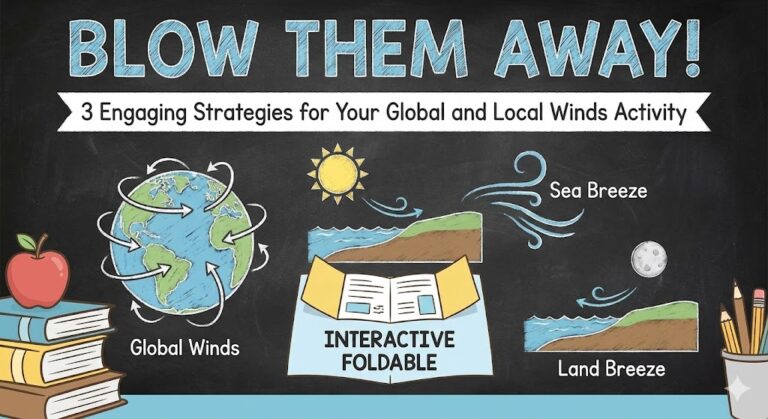
Let’s talk about teaching weather. Some topics are a breeze (pun intended!), like the water cycle. But when it comes to teaching global and local winds, things can get a little… gusty. Suddenly, we are throwing terms like “Coriolis Effect,” “Trade Winds,” and “Sea Breeze” at our students, and their eyes start to glaze over. How do we make these invisible forces feel real? How do we help them understand that the wind hitting their face at the beach is connected to the same concepts as the giant wind belts circling the planet? If you’ve been struggling to make your winds unit stick, here are three of my favorite, high-engagement strategies to bring these concepts to life in your classroom! 1. The “Convection Current” Demo Before we can understand wind, we have to understand convection. This simple demo is a showstopper and a perfect hook for your lesson. What you need: The magic: Place the heat source under one side of the water container and drop the ice on the other. Carefully add a few drops of red food coloring above the heat source and blue food coloring near the ice. Your students will watch in amazement as the warm, red water rises and moves across the top, while the cold, blue water sinks and moves across the bottom, creating a visible cycle. It’s the perfect visual for explaining how unequal heating of the Earth creates wind! 2. The “Winds of the World” Labeling Challenge Once they understand the why (convection), it’s time to tackle the where. I love using giant, collaborative maps for this. Draw a large outline of the world on butcher paper or project a map onto a whiteboard. Give groups of students sticky notes with different labels and arrows: “Equator,” “North Pole,” “Trade Winds,” “Westerlies,” “Polar Easterlies,” etc. Challenge them to place the labels and draw the wind arrows in the correct directions. It turns a dry diagramming activity into a collaborative puzzle. You can even add a competitive element by timing them! 3. The Ultimate Global & Local Winds Gallery Walk This is my go-to strategy for tying it all together. It gets students out of their seats, combines reading with movement, and gives them a chance to be independent learners. I recently started using this Global & Local Winds Gallery Walk, and it has been a fantastic addition to my unit. Here is why it’s a breath of fresh air: Instead of me lecturing, students rotate through 5 different stations, each featuring a specific type of wind: Polar Easterlies, Westerlies, Trade Winds, Sea Breeze, and Land Breeze. Each station has a short, easy-to-digest reading passage with a clear diagram. Students read the text and fill out a recording sheet with the wind’s name, a description, its direction, and its location. It’s a perfect way to reinforce reading for information skills while they learn science content. Plus, it’s student-led and no-prep for you! Just print the posters, tape them up, and let them go. It’s a great opportunity for you to circulate and help students who need extra support. You can grab this Global & Local Winds Gallery Walk activity here! Making Invisible Forces Visible Whether you are using food coloring to show convection or having students walk around the room to learn about the Westerlies, the goal is the same: to make these abstract concepts concrete. Do you have a favorite activity for teaching about wind and weather? Share your ideas in the comments below—let’s help each other blow our students away with awesome lessons!
Unwrapping Ancient Egypt: 3 Engaging Activities to Teach the Mummification Process

Let’s be honest: Is there any topic in social studies that grabs a student’s attention quite like mummification? The moment you mention “removing the brain through the nose,” you have the entire room captivated. It is the perfect blend of history, science, and just enough “gross factor” to keep even your most reluctant learners on the edge of their seats. But how do we move past the shock value and actually teach the deep cultural significance behind these rituals? How do we ensure they understand why the Ancient Egyptians went to such great lengths to preserve the body? If you are getting ready to dive into your Ancient Egypt unit, here are three of my favorite strategies to bring the mummification process to life in your classroom! 1. The Classic “Apple Mummification” Experiment If you have a week to spare for a science crossover, this is a must-do. It’s a fantastic visual representation of how desiccation (drying out) works. How it works: The students will be amazed to see how the “Natron” mixture preserves the apple slice, keeping it relatively fresh compared to the rotten control slice. It’s a powerful, hands-on way to demonstrate the science behind the history. 2. Canopic Jar “Design Challenge” To help students understand the religious aspect of preserving specific organs, I love having them design their own Canopic Jars. We talk about the four sons of Horus and which organ went into which jar (Imsety for the liver, Hapy for the lungs, etc.). Then, I challenge students to design a modern-day Canopic Jar. This creative twist helps them connect the concept of protection and preservation to their own lives. 3. The “Mummification Steps” Gallery Walk This is my absolute favorite strategy for the “meat and potatoes” of the lesson. Sometimes you need a resource that is rigorous, reading-focused, and gets students moving. I recently started using this Ancient Egypt Mummification Process Gallery Walk, and it is a total lifesaver for this unit. Here is why I love it: It breaks down the complex, 70-day process into 7 clear, manageable stations. Students walk around the room and investigate each step, from the Announcement of Death to the Opening of the Mouth ceremony. It covers all the key vocabulary—like Natron, Canopic Jars, and Resin—but in a way that is accessible for middle schoolers. They aren’t just memorizing gross facts; they are analyzing the purpose behind each step using a structured recording sheet. Plus, it is completely no-prep. You just print the 7 stations, hang them up, and let the students explore. It turns a standard reading lesson into an interactive museum exhibit right in your classroom. You can grab this Mummification Process Gallery Walk here! Bringing the Afterlife to Life Whether you are drying apples, designing jars, or walking through history, the goal is to help students see that mummification wasn’t just about death—it was about a deep love for life and a hope for eternity. Do you have a favorite “gross” history fact you love teaching? Let me know in the comments!
Going for Gold: 3 Winning Strategies to Bring the Winter Olympics into Your Classroom

Every four years, a special kind of magic takes over. The world pauses, we all suddenly become experts in curling, and we find ourselves cheering for athletes in sports we can barely pronounce. The Winter Olympics are coming, and let me tell you, the excitement in the classroom is palpable! As teachers, we know this is a golden opportunity. The Olympics aren’t just about sports; they are a gateway to teaching geography, history, perseverance, and cultural appreciation. But how do we harness that energy and turn it into meaningful learning, especially when we are already juggling a million other things? If you are looking for ways to bring the spirit of the 2026 Milano Cortina Games into your classroom without reinventing the wheel, here are three of my favorite, low-stress strategies to get your students engaged and learning. 1. The “Design Your Own Event” Challenge This is a fantastic way to blend creativity with critical thinking. I challenge my students to invent a brand-new winter sport that should be in the Olympics. They have to consider: Students can present their proposals to the class (“The International Olympic Committee”), who then vote on which new sport should be added to the games. It’s a fun, collaborative activity that gets them thinking about the logistics and spirit of athletic competition. 2. Olympic Math Medals Why not add an Olympic twist to your math practice? It’s amazing how much more engaging word problems become when they involve gold medals and world records. You can create problems based on real-world scenarios: For younger students, you can even track the medal count on a graph each day. It’s a simple way to integrate real-world data and make math feel relevant to a global event. 3. The Legendary “History of the Games” Gallery Walk This is my absolute favorite activity for this unit because it gets students out of their seats, combines history with reading comprehension, and is virtually no-prep for me. I recently started using this History of the Winter Olympics Gallery Walk, and it has been a total game-changer. Here is why it’s a gold-medal resource in my book: Instead of a dry lecture, students walk around the room to 7 different stations, each featuring an iconic moment from Winter Olympic history. We’re talking about stories that really capture their imagination, like the “Miracle on Ice,” the inspiring perseverance of “Eddie the Eagle,” and modern legends like Shaun White and Chloe Kim. What I love most is that the reading passages are designed for 6th-grade reading levels, so they challenge students to read for detail, not just skim for bullet points. They have to actually read the full paragraphs to find the facts for their recording sheet. It’s the perfect way to build those crucial reading skills while keeping them engaged in high-interest content. I just print the posters, tape them to the walls, give students the recording sheet, and let them go! It’s a fantastic, self-paced activity that frees me up to facilitate and check in with individual students. You can grab this no-prep History of the Winter Olympics Gallery Walk here! Let the Games Begin! Whether you’re designing new sports, crunching Olympic numbers, or taking a walk through history, the most important thing is to tap into the excitement of the games. It’s a wonderful way to connect your classroom to the wider world and inspire your students with stories of dedication and triumph. Do you have a favorite Winter Olympics activity? Share your ideas in the comments below—let’s help each other make this an Olympic-sized success in our classrooms!
Athens vs. Sparta: 3 Engaging Activities to Bring Ancient Greece to Life

If there is one unit that students seem to consistently love, it’s Ancient Greece. Maybe it’s the mythology, maybe it’s the Olympics, or maybe it’s just the idea of Spartans looking cool in movies. But when we get to the nitty-gritty of comparing city-states—specifically Athens and Sparta—I sometimes find myself hitting a wall. How do we move beyond a simple Venn Diagram? How do we get students to actually feel the difference between a society valued for its mind (Athens) and one valued for its muscle (Sparta)? Over the years, I’ve tried to spice up this specific lesson to get my students out of their seats and thinking critically. If you are looking for ways to shake up your Ancient Greece unit, here are three of my favorite strategies for teaching Athens vs. Sparta! 1. The “Real Estate Agent” Pitch I love an activity that blends creative writing with historical facts. For this one, I divide the class in half. One half represents the “Athens Chamber of Commerce,” and the other half represents the “Spartan Recruitment Office.” Their goal? Create a brochure or a 60-second “elevator pitch” to convince a neutral Greek citizen to move to their city-state. It’s a fun, quick way to check if they understand the cultural values of each city-state, and the presentations are usually hilarious. 2. The Structured “Sides of the Room” Debate Debates can be chaotic in middle school if they aren’t structured, so I keep this one physical and simple. I place a sign that says “Athens” on one wall and “Sparta” on the other. I read a statement, and students have to physically walk to the side of the room that they think the statement describes. Statements might include: Once they are on their chosen side, I call on one or two students to explain why they moved there. This gets the blood flowing and works as a fantastic formative assessment—you can instantly see who is grasping the concepts and who is following the crowd! 3. The Ultimate Comparison Gallery Walk This is my absolute favorite strategy because it combines movement with deep content analysis. Sometimes you just need a resource that is ready to go, rigorous, and keeps students accountable. I recently started using this Athens vs. Sparta Comparison Gallery Walk, and it has been a game-changer for this unit. Here is why I love it: It literally transforms the classroom into a museum. Instead of a lecture where eyes might glaze over, students rotate through 6 different “stations” that cover the core differences: Government, Education, Economy, Military, Values, and Social Classes. It is incredibly low-prep—you just tape the stations to the wall and hand out the recording sheet. I really appreciate how it breaks down complex topics like “Direct Democracy vs. Oligarchy” or “International Trade vs. Isolated Farming” into chunks that students can actually digest as they walk around. By the time they finish the rotation, they have a full recording sheet of evidence they can use to write a comparison essay or jump into that debate I mentioned earlier. It hits all those Reading History standards while keeping the kids moving. You can grab the Athens vs. Sparta Gallery Walk activity here! Keeping History Alive Whether you are pitching real estate, debating across the room, or doing a deep-dive gallery walk, the goal is the same: help students see these city-states not just as dots on a map, but as real places where real people lived. Do you have a favorite way to teach Ancient Greece? Let me know in the comments—I am always looking to add to my toolbox!
4 Engaging Valentine’s Day Activities for Upper Elementary (That Aren’t “Cringe”)

Let’s be real for a second: Valentine’s Day in upper elementary and middle school is a wild ride. You’re balancing the inevitable sugar crash, the heightened social dynamics, and that tricky line between “festive” and “babyish.” If you teach 4th grade and up, you know that the cute little cartoon valentines and simple crafts we loved in primary grades just don’t hit the same way anymore. In fact, if you try to force it, you might just get an eye roll. But that doesn’t mean we skip the holiday! It just means we have to level up our game. Over the years, I’ve found that the secret to surviving (and actually enjoying) February 14th with big kids is finding activities that are relatable, engaging, and—dare I say—a little bit cool. Here are four of my favorite strategies for celebrating Valentine’s Day with older students, including a set of cards that will finally earn you some “cool teacher” points. 1. “Love Letter” to a Character (Literacy Activity) We are always looking for ways to sneak in some rigorous writing practice, right? Instead of generic poetry, have students write a “Break-Up Letter” or a “Love Letter” to a character from their current novel study or independent reading book. How it works: 2. Speak Their Language with “Brain Rot” Valentines Okay, this is the one I am most excited to share with you this year. If you spend any time around students aged 10-14, you know they have their own language. Words like “mid,” “no cap,” and “vibes” are flying around my classroom constantly. Usually, I just smile and nod, but this year, I decided to lean into it. I found these Brain Rot Valentine’s Day Cards and they are an absolute game-changer. Why I love them: If you want to be the teacher who passes the “vibe check” this year, grab these cards here. Trust me, they are far from “cringe.” 3. The “Compliment Bag” Challenge This is a classic for a reason. In upper grades, we shift the focus from candy to kindness. The Strategy: It turns a chaotic candy exchange into a really sweet social-emotional learning moment. 4. Valentine’s Day “Math Libs” When in doubt, make it academic but silly. I love taking standard word problems and replacing the names and scenarios with over-the-top dramatic Valentine’s tropes. It’s a simple tweak that gets a laugh and keeps them doing the math. How are you celebrating this year? Whether you go full academic or just take a chill day to build relationships, remember that your students just want to feel seen. And if you can do that while using the word “sigma” correctly in a sentence? Well, that’s just a bonus. Happy Valentine’s Day, teachers!