Cold War Events Gallery Walk Ideas for Social Studies
Cold War events can be tricky for students because so much is happening at once. You have alliances, threats, technology, speeches, walls, races, crises, and big feelings between countries. It is a lot for students to keep straight if the lesson is only notes and a timeline.
I like using a Cold War Events Gallery Walk because it breaks the topic into smaller pieces. Students can read one event at a time, move around the room, and slowly build the bigger picture of why the Cold War shaped the United States and the world.
Start With the Big Question
Before students rotate through stations, give them one simple question to carry with them:
How did this event increase tension, lower tension, or change the way people viewed the Cold War?
That one question keeps the activity from turning into copy-the-answer practice. Students are still reading for details, but they also have to think about why each event mattered. It also gives you an easy discussion point when everyone comes back together.
Use Stations to Make the Timeline Feel Less Overwhelming
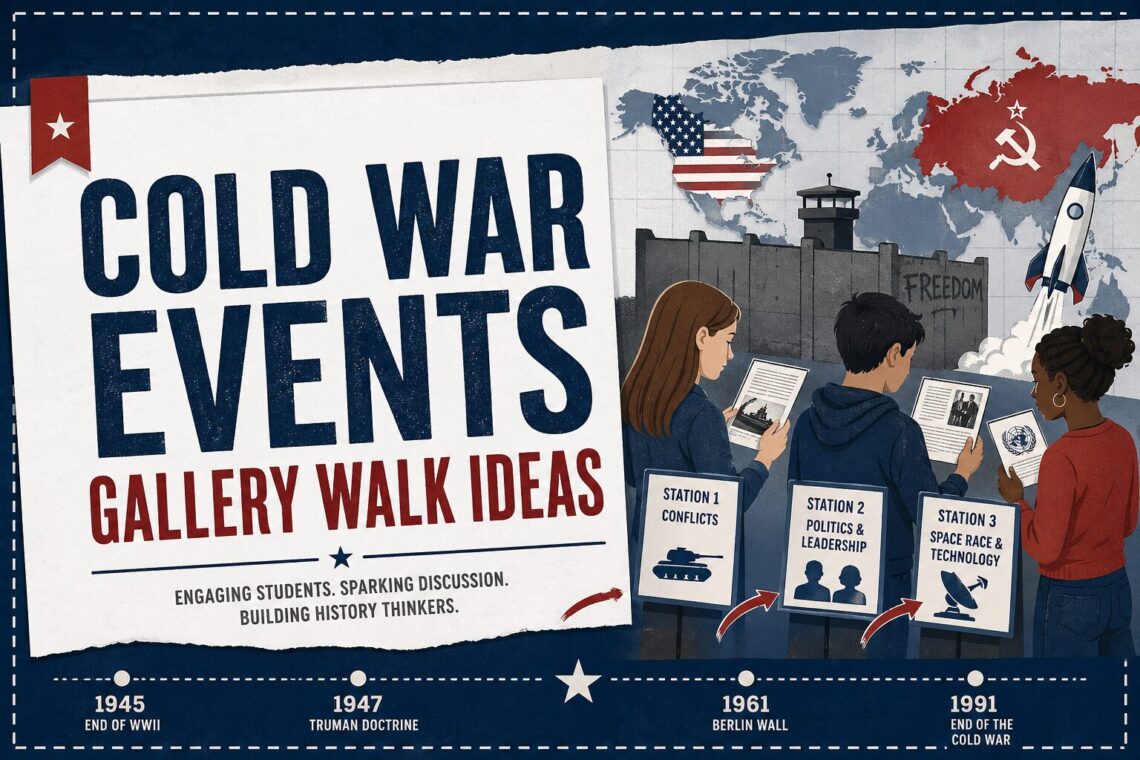
A Cold War gallery walk works well because students do not have to absorb the entire unit at once. Each station can focus on one event, like the Berlin Wall, Space Race, Cuban Missile Crisis, Arms Race, Sputnik Crisis, Iron Curtain Speech, or Marshall Plan.
My favorite setup is simple: students read the station card, record the countries involved, summarize the event, and explain its impact on the United States. Nothing fancy. Just enough structure to make sure they are reading carefully and not just wandering around the room pretending to be busy. We have all seen that version too. 🙂
Add Quick Partner Talk Between Stations
If your class needs more discussion, build in a tiny partner-talk routine. After every two or three stations, students can pause and answer one prompt together:
- Which event felt most dangerous so far?
- Which event was more about ideas than weapons?
- Which event changed how Americans viewed the Soviet Union?
- Which event connects most to technology or competition?
These quick pauses help students retrieve what they just read. Having students crawl back into their memory often is so necessary, especially with a topic that has this many names and events.
Feature the Resource When You Need a Ready-to-Go Option
I’m biased because I created this one, but my Cold War Events Gallery Walk is made for exactly this lesson style. It includes reading stations for major Cold War events, plus a student answer sheet so students have a clear purpose as they rotate.
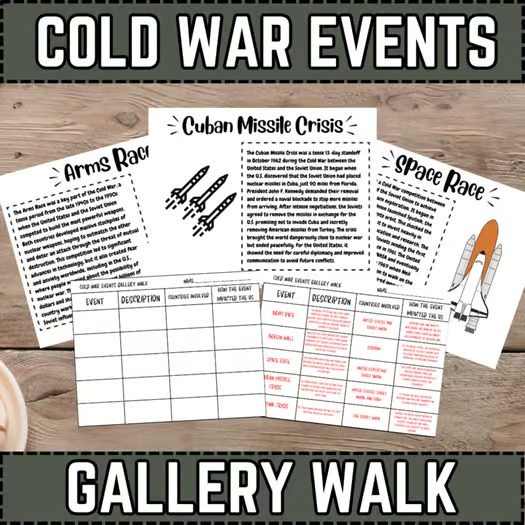
It is a good fit if you want an interactive Cold War activity without building every passage and question from scratch. Students get the movement piece, the reading piece, and the written accountability piece all in one lesson.
You can use it during a Cold War unit, as a review before a test, or as a way to introduce several major Cold War events before going deeper into discussion.
Wrap Up With a Simple Ranking Task
After the gallery walk, I like ending with a quick ranking question. Ask students to choose the three most important Cold War events from the activity and defend their choices.
- Most important event:
- Why it mattered:
- Evidence from the station:
This gives students a reason to compare events instead of treating them like isolated facts. It also makes a strong exit ticket because you can quickly see who understood the bigger Cold War story.
A Cold War Events Gallery Walk does not have to be complicated. If students are reading, moving, writing, and discussing, you are already giving them more ways to make the topic stick. And for a unit that can feel pretty abstract, that little bit of movement and structure really helps.
