Colonists Protests Gallery Walk Activity for Upper Elementary Social Studies
Teaching the road to the American Revolution can get tricky fast because there are a lot of events, laws, and protests for students to keep straight. The Boston Tea Party is usually the one they remember, but it makes a lot more sense when students also understand the other ways colonists pushed back against British rule.
That is why I like slowing this topic down and giving students a chance to move, read, talk, and summarize. A colonists protests gallery walk is a simple way to help students see that colonial resistance was not just one dramatic event. It was boycotts, petitions, public pressure, and organized action over time.
Start with the Big Question
Before students read about specific protests, I like to give them one guiding question: How did colonists respond when they believed British rule was unfair?
That question gives students a purpose for reading. Instead of memorizing isolated facts, they are looking for patterns. Some colonists protested by refusing to buy British goods. Some wrote letters and petitions. Some took part in public demonstrations. Others used intimidation, like tarring and feathering, to pressure tax collectors and loyalists.
Use Stations to Break the Topic into Manageable Pieces
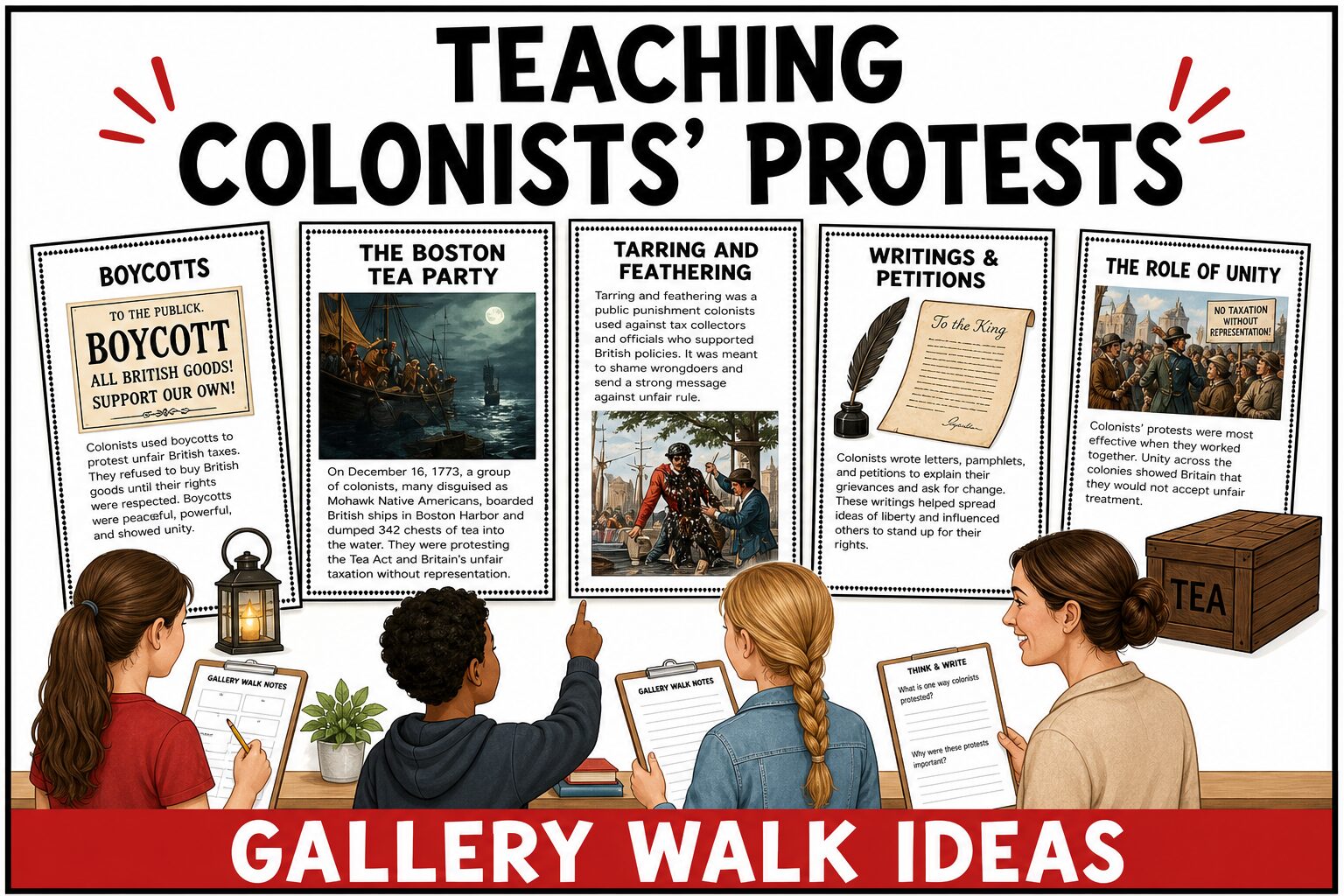
Colonial protests are easier for upper elementary students to understand when the information is broken into smaller chunks. Instead of giving students one long reading passage, set up short stations around the room.
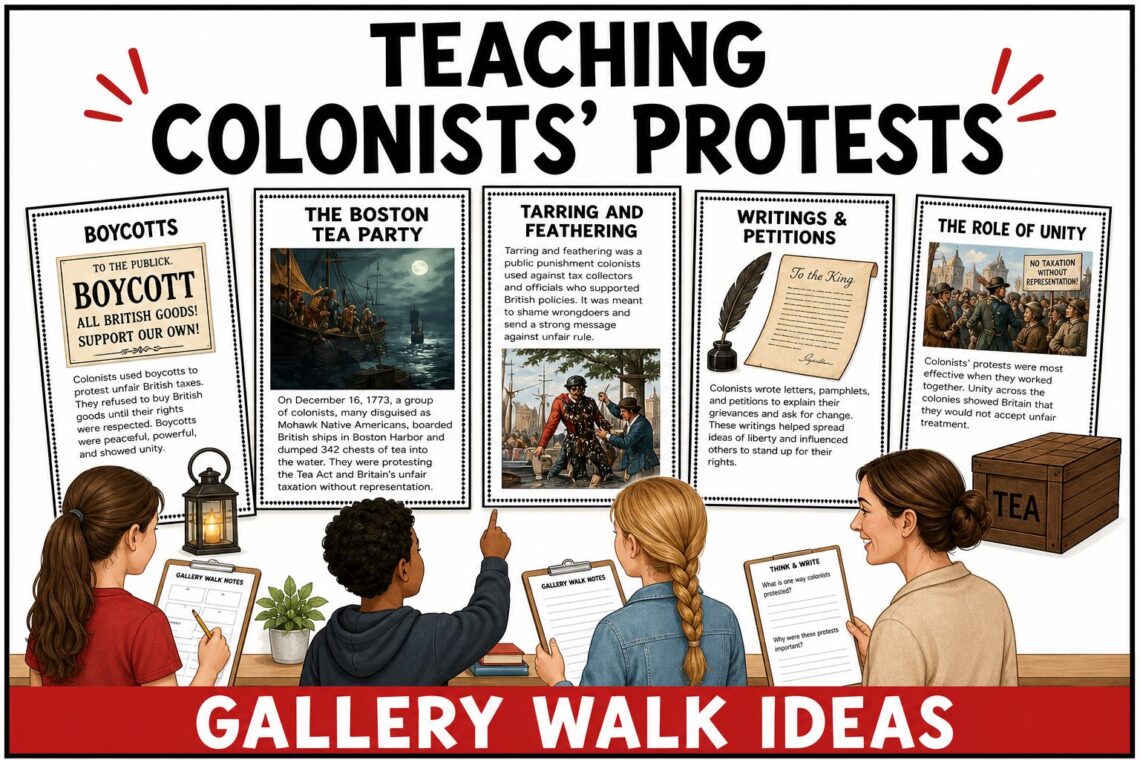
Each station can focus on one protest method, such as:
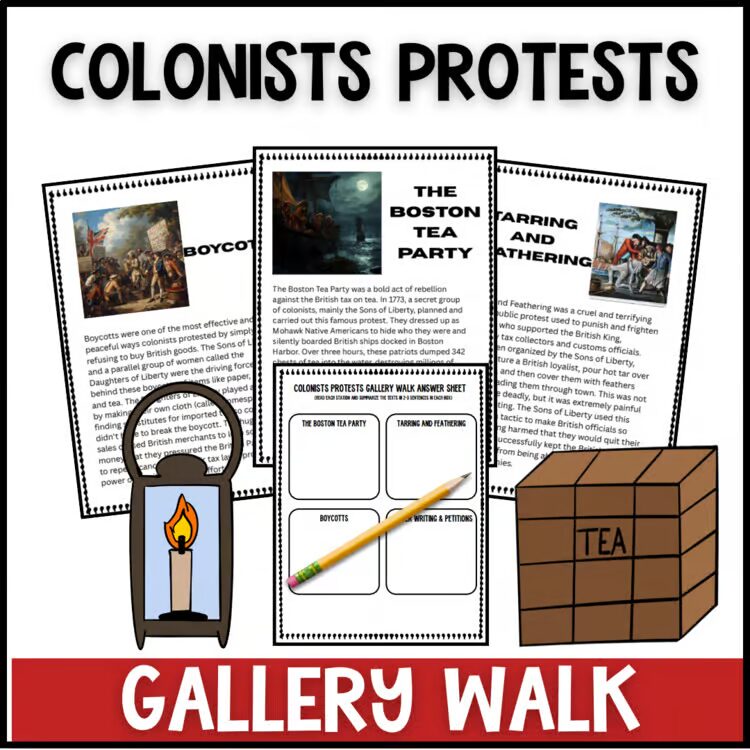
- The Boston Tea Party
- Tarring and feathering
- Colonial boycotts
- Letter writing and petitions
Students rotate, read, and record a short summary at each stop. This keeps the lesson moving and helps students practice finding the main idea instead of copying every detail.
Focus on Summarizing, Not Just Facts
One of the best parts of teaching this topic with a gallery walk is that it naturally builds reading comprehension skills. After each station, ask students to write a two- or three-sentence summary. That small limit matters because it forces them to decide what is most important.
If your students need support, give them a sentence frame like:
Colonists protested by ______ because ______. This showed ______.
That structure helps students connect the action to the reason behind it, which is exactly what they need to understand before moving deeper into the causes of the American Revolution.
Make Movement Purposeful
Gallery walks are great, but they work best when the movement has a clear routine. I usually recommend giving students a set amount of time at each station, then rotating together. This keeps students from crowding one station or racing through the reading.
You can also have students work with a partner. One student reads first, the other helps summarize, and then they switch roles at the next station. It keeps everyone involved without turning the room into chaos.
A Low-Prep Colonists Protests Gallery Walk
If you want this lesson already put together, I made a Colonists Protests Gallery Walk for this exact topic. It includes informational reading stations, a student answer sheet, and a completed teacher answer key.
The activity is designed for 4th and 5th grade social studies and works well as an introduction, review, or part of a larger Colonial America/American Revolution unit.
Bring the Road to Revolution to Life
Students do not need to memorize every colonial protest in isolation. They need to understand how frustration with British rule grew and how colonists responded in different ways. A gallery walk gives them a concrete way to compare those responses, practice summarizing, and make sense of the bigger story leading up to the American Revolution.
If you are building out your Colonial America or American Revolution unit, this is a great lesson to use before diving into Lexington and Concord, the Declaration of Independence, or the war itself.
Grab free no-prep science & social studies resources
Get instant access to review templates, vocabulary posters, gallery walk samples, quick-check activities, and hands-on practice ideas for upper elementary and middle school.

Trey
Trey creates low-prep science, social studies, and ELA resources for upper elementary and middle school teachers through A Dad’s Classroom.