How to Teach World Cup History with a Gallery Walk Activity
Teaching World Cup history can be a really fun way to bring sports, geography, reading, and social studies together. The tricky part is that the World Cup has a long history, and if students only hear about it through a lecture, the names, dates, countries, and big moments can blur together pretty fast.
That is why I like turning World Cup history into a gallery walk. Students are still reading and recording important information, but they are also moving around the room, looking closely at each event, and building a timeline of how the tournament has changed over time.
Start with the question students need to answer
Before students begin reading, I like giving them one simple purpose: What makes this World Cup moment important?
That question keeps the lesson focused. Students are not just hunting for random soccer facts. They are looking for the year, the teams involved, the host country, the result, and why that moment mattered in World Cup history.
You can also add a quick warm-up question before the gallery walk starts:
- Why do major sporting events become part of history?
- How can one game or tournament change the way people remember a player, team, or country?
- What makes a sports moment memorable years later?
Those questions help students think beyond the final score. They start seeing the World Cup as a global event with stories, patterns, and turning points.
Use World Cup reading stations to break the history into smaller pieces
World Cup history is much easier for upper elementary and middle school students to understand when it is broken into short reading stations. Instead of giving students one long article, each station can focus on one important tournament, player, or moment.
A good World Cup history gallery walk might include moments like the first tournament in 1930, famous championship games, legendary players, host countries, and the way the tournament grew into a worldwide event.
At each station, students can record:
- the year
- the teams or people involved
- the host country
- the final result
- why the event mattered
That repeated structure helps students know exactly what to look for. It also makes the reading feel more manageable because they are only handling one piece of history at a time.
Make the movement purposeful
Gallery walks work best when the movement is structured. I usually like setting up stations around the room and giving students a clear recording sheet before they start. Then students rotate, read, write, and move to the next station.
A few simple routines help a lot:
- Number the stations clearly.
- Use a timer if your class needs help pacing.
- Let students work with a partner, but have each student record their own answers.
- Pause halfway through if you notice students rushing or missing the main idea.
The goal is not just to get students out of their seats. The goal is to make the reading feel active without losing the structure of the lesson.
Build in geography while students read
One of the best parts of teaching World Cup history is that geography fits naturally. Every station gives students a chance to notice countries, continents, host nations, and how global the tournament really is.
You can keep this simple. Have students locate the host country on a map after each station, or ask them to track which continents appear most often. If you want a quick extension, students can choose one host country and write a short response about why hosting a major world event might matter.
This makes the lesson more than a sports reading activity. Students are practicing reading comprehension, geography, and historical thinking at the same time.
A low-prep World Cup history activity
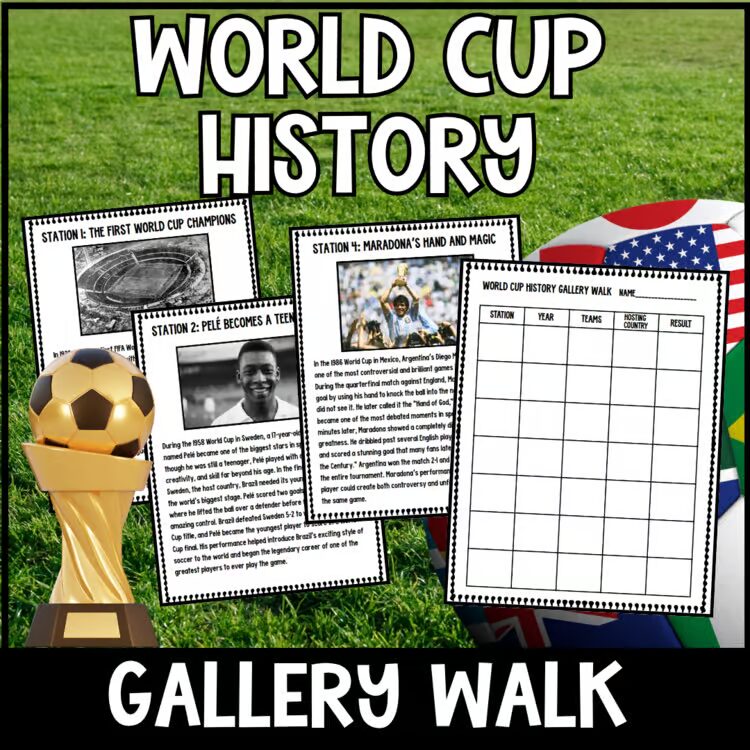
If you want this already put together, I created a History of the World Cup Gallery Walk for grades 4-8.
It includes 7 detailed station posters, a student recording sheet, a teacher answer key, student directions, and an editable Canva link. Students read about major World Cup moments, including the first tournament in 1930 and Lionel Messi finally lifting the trophy in 2022. As they rotate, they record the year, teams involved, host country, and final result.
I like this format because it gives students a real reason to read carefully. They cannot just skim for one answer and move on. They have to pull out details, compare events, and notice how each moment fits into the bigger history of the World Cup.
Wrap up with a quick discussion or ranking
After the gallery walk, bring students back together for a short reflection. You do not need anything complicated. A quick discussion or exit ticket can help students process what they read.
Try questions like:
- Which World Cup moment was the most surprising?
- Which event do you think had the biggest impact on soccer history?
- How has the World Cup changed over time?
- What do these moments show about why sports matter around the world?
You can also have students rank the events from most important to least important. There is not one perfect answer, which is what makes the discussion useful. Students have to use evidence from the stations and explain their thinking.
If you already use movement-based lessons in social studies or reading, this pairs well with other gallery walk routines too. For example, I use a similar structure when teaching Revolutionary War leaders with a gallery walk because students can read one focused station at a time, gather key details, and then compare what they learned.
World Cup history is a great topic for that same routine. Students get sports, geography, reading practice, and a little global history all in one low-prep lesson.
Grab free no-prep science & social studies resources
Get instant access to review templates, vocabulary posters, gallery walk samples, quick-check activities, and hands-on practice ideas for upper elementary and middle school.

Trey
Trey creates low-prep science, social studies, and ELA resources for upper elementary and middle school teachers through A Dad’s Classroom.