How to Teach The Odyssey with Reader’s Theater
The Odyssey is one of those stories students are more likely to remember when it feels active. The monsters, gods, choices, conflicts, and long journey all lend themselves to performance, discussion, and quick character work.
That is why The Odyssey reader’s theater can work so well in a middle school ELA classroom. Instead of asking students to only read about Odysseus, Athena, the Cyclops, the Sirens, and Penelope, reader’s theater lets them step into the story and hear the conflict out loud.
Start with the story students need to understand
Before students perform, they need enough context to follow the journey. A short overview of the Trojan War, Odysseus’s goal of returning home, and the role of the gods gives students a helpful frame without turning the lesson into a lecture.
I like keeping the setup simple: Who is trying to get home? What obstacles are in the way? Which characters help or hurt him? Those questions give students something to listen for while they read and perform.
Use roles to build comprehension
Reader’s theater is not just about reading lines. It gives students a reason to pay attention to character motivation, tone, and conflict. A student reading as Odysseus has to think about confidence, frustration, pride, and leadership. Reading as Athena brings in guidance and strategy. The Cyclops role asks students to consider power, anger, and point of view.
That role-based reading helps students slow down and notice details they might skim over in a traditional passage. Even students who are not performing can track what each character wants and how the scene moves the journey forward.
Keep performance low-pressure
Middle school students usually do better when performance feels structured instead of wide open. You do not need costumes, props, or a stage for reader’s theater to work. A clear script, assigned roles, and a few expectations for voice and pacing are enough.
For reluctant readers, small-group performance can feel safer than reading in front of the whole class. For more confident students, a whole-class performance can turn into a memorable unit activity. Either way, the goal is comprehension first. The acting is there to support the reading, not replace it.
Add quick character analysis
After a scene, have students pause and analyze one character. They can identify a trait, choose a line that shows it, and explain how that character affects the story. This works especially well with Odysseus because students can debate whether his choices show bravery, cleverness, pride, or recklessness.
You can also connect character analysis to theme. When students discuss perseverance, temptation, loyalty, or pride, they are moving beyond plot summary and into the bigger ideas that make the epic worth teaching.
Connect The Odyssey to the Hero’s Journey
The Odyssey is a natural fit for the Hero’s Journey because students can see the call to adventure, trials, helpers, obstacles, and return home in a story that is full of action. After performing a scene, ask students where that moment fits in the journey.
This does not need to be complicated. Students can use a quick chart, sticky notes, or a short written response. The important part is helping them see how individual scenes connect to the larger structure of the epic.
If you want another way to structure a longer ELA unit, this Project Hail Mary novel study activities post has practical ideas for chapter questions, vocabulary, discussion, writing, and assessment that can transfer well to other novel or epic units.
Extend the activity with writing
Reader’s theater also gives students a strong jumping-off point for writing. After performing, students can write from a character’s point of view, create a new mythological character, explain a theme, or rewrite a scene with a different outcome.
Because they have already heard the conflict and character voices out loud, students often have more to say. The performance gives them a shared experience to reference in their writing.
A ready-to-use Odyssey reader’s theater option
If you want the script and follow-up activities ready to go, I created a The Odyssey reader’s theater activity for middle school ELA and social studies. It includes a five-scene script, a full character list with 15+ roles, a character profile worksheet, a create-a-god-or-goddess activity, a narrative writing prompt, an eight-question comprehension quiz, an answer key, and teacher directions.
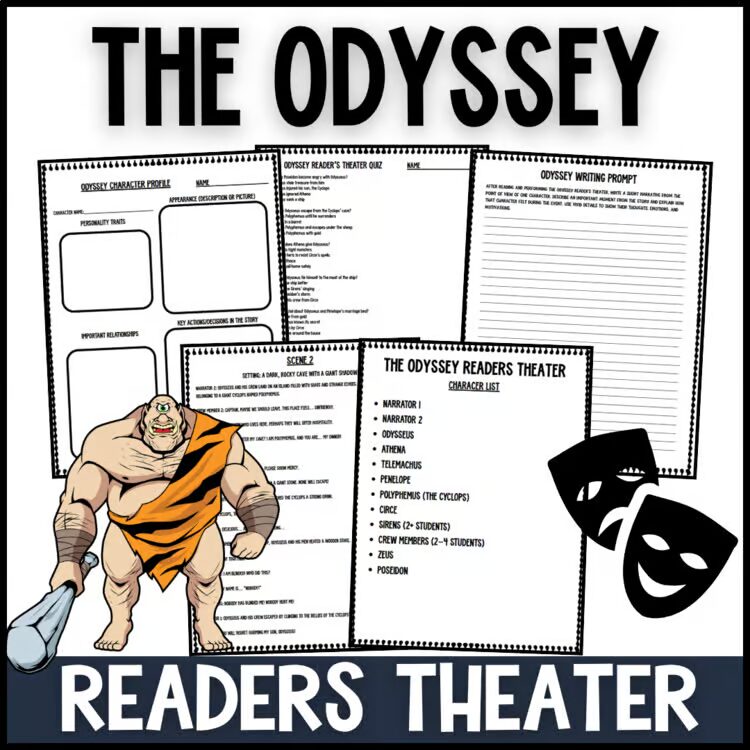
You can use it as a whole-class performance, small-group rotation, unit introduction, mythology review, or Hero’s Journey activity. It is designed to help students understand the story while still giving them a more active way to work with the text.
Final thought
The Odyssey can feel distant to students at first, but reader’s theater helps bring the story closer. When students read the roles, hear the conflict, and talk about character choices, they are more likely to understand the journey and remember the big ideas behind it.
Grab free no-prep science & social studies resources
Get instant access to review templates, vocabulary posters, gallery walk samples, quick-check activities, and hands-on practice ideas for upper elementary and middle school.

Trey
Trey creates low-prep science, social studies, and ELA resources for upper elementary and middle school teachers through A Dad’s Classroom.