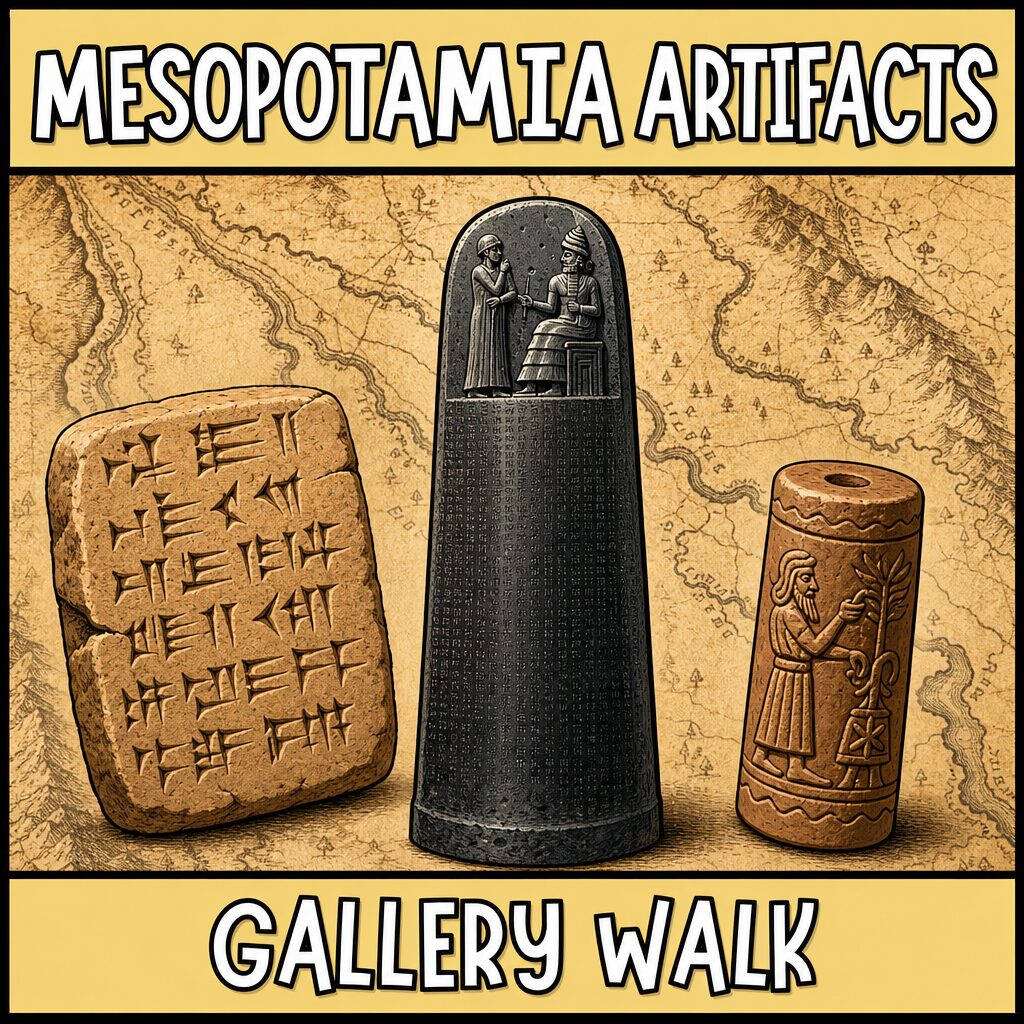
How to Teach Mesopotamia Artifacts with a Gallery Walk
Ancient Mesopotamia can be hard for students to picture because so much of the unit feels far away from their everyday lives. Students may learn words like cuneiform, city-state, ziggurat, empire, and irrigation, but those terms become much more meaningful when they can connect them to real objects people used, built, wrote on, or left behind.
That is why artifacts are such a helpful entry point. A Mesopotamia artifacts lesson gives students something concrete to study. Instead of only asking students to memorize facts about the Fertile Crescent, you can ask them to look closely at evidence and think like historians.
A gallery walk is one of my favorite ways to make that happen because it keeps the lesson structured while still getting students moving, reading, sketching, and talking about what they notice.
Start with the historian question
Before students begin reading about artifacts, give them one simple question to carry through the activity:
What can artifacts tell us about how people lived in ancient Mesopotamia?
That question helps students understand the purpose of the lesson. They are not just rotating around the room to fill in blanks. They are using objects as evidence.
You can introduce the idea by showing one familiar classroom object and asking students what a future historian might learn from it. A pencil, water bottle, or laptop can reveal clues about tools, school routines, technology, and daily life. Then students can apply that same thinking to Mesopotamian artifacts.
Use stations to break the reading into manageable pieces
Mesopotamia includes a lot of important content, and a long reading passage can overwhelm students quickly. Gallery walk stations help because each stop gives students one focused artifact to study.
At each station, students can read a short passage and record a few key details, such as:
- the name of the artifact
- what it looks like
- what it was used for
- what it reveals about Mesopotamian life
This structure works especially well for middle school ancient civilizations classes because students have a clear task at every stop. They know what to look for, but they still have to think beyond the surface details.
Build in visual literacy
Artifacts are perfect for visual literacy practice. Students should not only read about the object. They should also slow down and notice what the artifact shows.
You can ask students to sketch the artifact or record visual details before they explain its purpose. That small step matters because it keeps students from racing through the station. It also helps them connect the appearance of an artifact to its historical meaning.
For example, if students study a cuneiform tablet, they can notice the wedge-shaped marks before connecting the artifact to writing, record keeping, laws, or trade. If they study a stele, they can think about why laws or images might be carved into stone and displayed publicly.
Turn artifacts into discussion
After the gallery walk, students need a chance to put the pieces together. A quick discussion can help them move from individual artifacts to bigger conclusions about Mesopotamian civilization.
Try prompts like:
- Which artifact taught you the most about daily life?
- Which artifact showed power or leadership?
- Which artifact connected to writing, laws, or government?
- What do these artifacts reveal about what Mesopotamians valued?
These questions push students to use evidence from the stations. They also help students see that artifacts are not random objects. They are clues about a society’s technology, beliefs, government, work, and culture.
Connect artifacts to key vocabulary
A Mesopotamia artifacts gallery walk also pairs naturally with vocabulary instruction. Terms like cuneiform, city-state, scribe, irrigation, ziggurat, and empire are easier to remember when students can connect them to images, objects, and examples.
If your students need more vocabulary support before or after the gallery walk, you might also like this post on using an Ancient Mesopotamia vocabulary word wall. A word wall gives students a reference point as they read, write, and discuss the unit.
A ready-to-use Mesopotamia artifacts option
If you want the stations already built, I created an Ancient Mesopotamia Artifacts Gallery Walk for 6th and 7th grade world history and ancient civilizations classes.
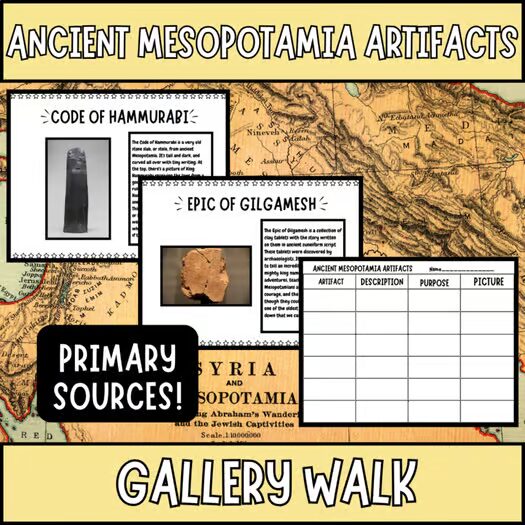
The activity is designed to help students analyze artifacts as primary sources. Students rotate through stations, read about each artifact, describe what they notice, explain its purpose, and draw the artifact as part of their response.
You can use it to introduce Mesopotamian civilization, review key concepts later in the unit, or add a primary source lesson when students need something more interactive than another set of notes.
Make the evidence visible
The biggest benefit of teaching artifacts is that students can see history as evidence. A law code, tablet, statue, seal, or piece of writing can help them understand that ancient civilizations were made up of real people solving problems, building systems, recording information, and expressing what mattered to them.
When students leave the activity, they should be able to explain more than what an artifact is. They should be able to explain what it shows about life in ancient Mesopotamia. That is where the deeper learning starts.
Grab free no-prep science & social studies resources
Get instant access to review templates, vocabulary posters, gallery walk samples, quick-check activities, and hands-on practice ideas for upper elementary and middle school.

Trey
Trey creates low-prep science, social studies, and ELA resources for upper elementary and middle school teachers through A Dad’s Classroom.