
Severe Weather Gallery Walk Activities for Teaching Storms
Teaching severe weather is usually not a hard sell. Most students are already curious about tornadoes, hurricanes, blizzards, floods, wildfires, and thunderstorms. The hard part is keeping that curiosity focused so class does not turn into forty random storm stories in a row.
My favorite fix is a severe weather gallery walk. It gives students a reason to get up, read, write, and compare different storms without losing the science. It feels active, but they are still working with vocabulary, causes, locations, dangers, and safety tips.
Give students one severe weather question to carry with them
Before students start rotating, I like giving them one big question to think about: “How are severe weather events different, and how can people stay safe during them?” Simple, but it keeps the whole activity from becoming a scavenger hunt of random facts.
As students read about tornadoes, hurricanes, ice storms, floods, hail, blizzards, dust storms, wildfires, and severe thunderstorms, they start noticing patterns. Some storms are tied closely to location. Some are more about temperature changes. Some have similar safety rules. That comparison is where the learning gets better.
Use storms reading stations instead of one giant passage
Severe weather can be a lot if students get all the information at once. Storms reading stations break it into friendlier chunks. Students read about one event, pull out the important details, and then move on.
I like this for upper elementary and middle school science because it naturally builds in variety. Students are reading, moving, talking a little, and writing. You also get a chance to walk around, listen for misconceptions, and quickly see who is just copying words versus actually understanding the storm.
Have students track the same details at every station
To keep the severe weather gallery walk organized, use the same categories for each event. I usually want students looking for:
- Where the severe weather event usually happens
- What conditions create it or what it looks like
- What dangers it can cause
- How people can stay safe
Those repeated categories make it much easier to compare storms later. Students can see that floods, tornadoes, hurricanes, and ice storms are different, but each one still connects back to preparation and safety.
A severe weather gallery walk resource
If you want the stations already made, I’m biased because I created this one, but this Severe Weather Gallery Walk | Storms Reading Stations Activity is a really nice fit for a storms unit. Students rotate through severe weather events, read short passages, and complete an answer sheet as they go.
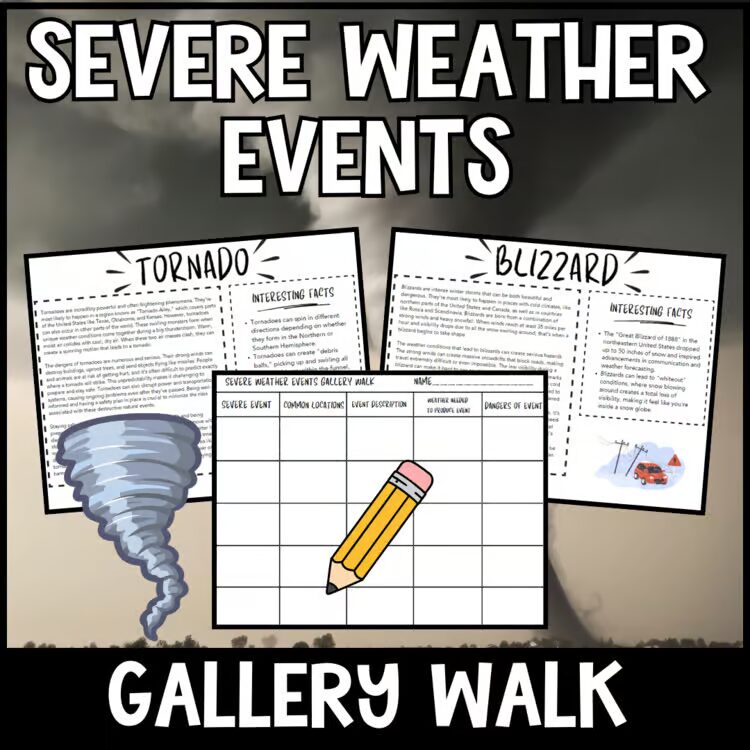
It includes tornadoes, hurricanes, blizzards, dust storms, hail storms, wildfires, severe thunderstorms, floods, and ice storms. It is perfect when you want students reading and writing, but you also want the room to feel a little more alive than a normal worksheet day.
Do a quick compare-and-discuss debrief
Do not let the activity end the second the answer sheet is done. Have students crawl back into their memory for a few minutes. Ask which severe weather events had similar dangers, which ones depended most on location, or which safety tips showed up more than once.
You can also ask students which storm they think would be hardest to prepare for and have them defend their answer with evidence from the stations. That little discussion helps turn the notes into actual understanding.
A severe weather gallery walk works because it has variety. Get students reading. Get them moving. Get them looking. Get them writing. If you want a ready-to-use storms activity, you can check out the Severe Weather Gallery Walk storms reading stations activity here.

